

If you enjoy working by hand, around the house, or during renovations, an oscillating multi-tool is just for you. Small, good-looking, and fully portable, it could cut, sand, scrape, or trim in places where other tools would simply be too big or awkward to go. Once they step into your life, suddenly, you see a plethora of things they could do.
In this guide, we will explain what an oscillating multi-tool is made for, which features pass the test for comparison, and how to match one tool to the projects at hand.
Understanding Oscillating Multi-Tools
Before diving in depth, it is better to start with some understanding of what this tool really is and how it performs.
What Is an Oscillating Multi-Tool?
An oscillating multi-tool is a small, powerful hand-held tool that moves the head back and forth through a small arc at high speed. With very tiny controlled motions, you plunge cut into the surface, sand in corners against a wall or floor, or work without the tool slipping from your grip. No start hole like with a jigsaw is needed. That controlled movement is actually what makes it one of the most versatile tools in today’s toolbox.
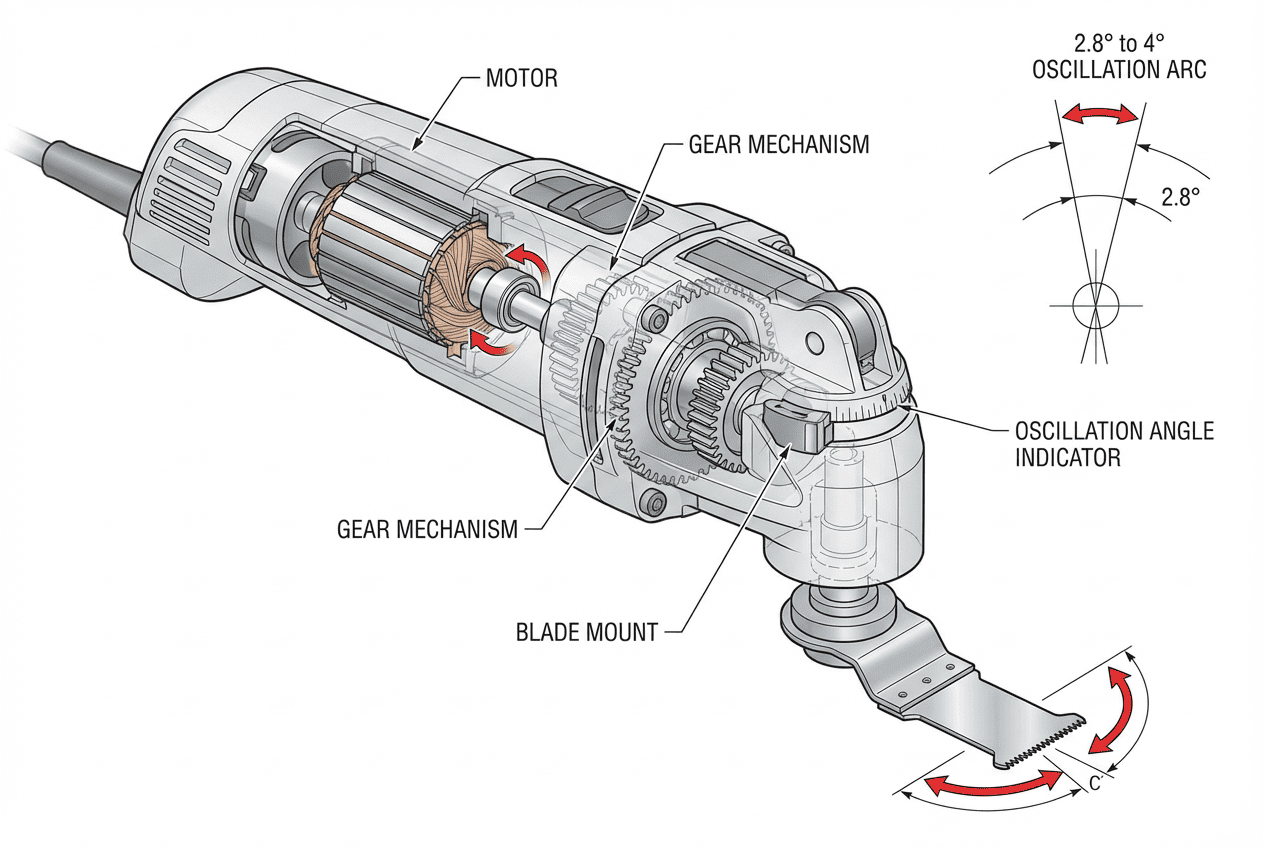
Key Components & How They Work
There is a motor inside the body of the tool that rotates. A gear mechanism transforms the rotary motion into oscillating motion of the head. The angle at which such oscillation occurs is dubbed “oscillation angle”. A larger oscillation angle will consequently translate to a faster and more aggressive cutting action; conversely, a smaller angle feels smoother to work.
Types of Oscillating Tools for Cutting
Oscillating tools come in corded versions for continuous power and shop use, and cordless bandsaw versions for portability and tight spaces; compact/lightweight models suit DIYers and occasional jobs, while heavy-duty pro tools handle daily, demanding use. Multi-tool kits (with batteries and accessories) are best for beginners or those starting from scratch, whereas bare tools are ideal if you already own compatible batteries and just need to expand your tool lineup.
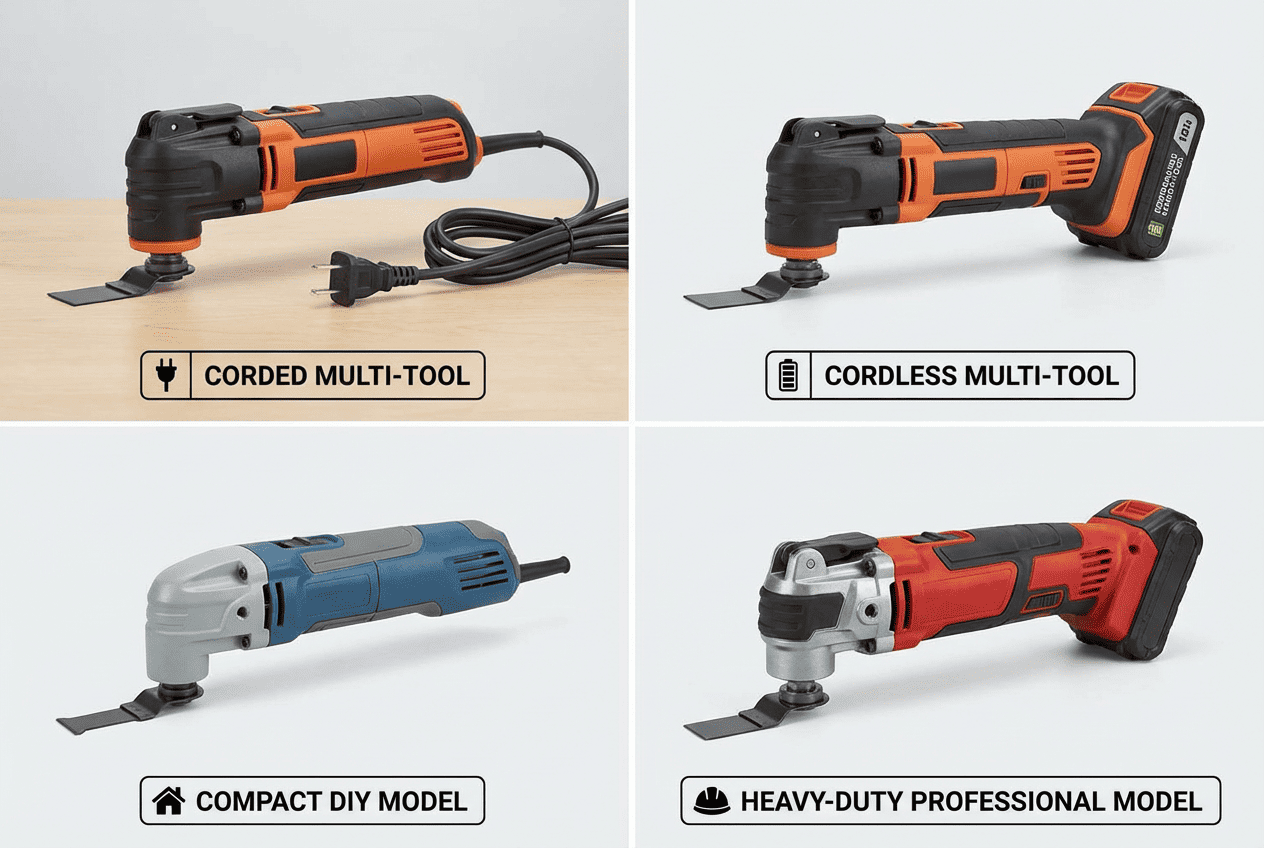
Oscillating Multi-Tool Features to Consider
The most important Features to consider in oscillating tools are those of power, efficiency, ergonomics, accessories, and the brand.
Kraft und Leistung
The power for Corded oscillating multi-tools is usually given in amps, whereas for Cordless oscillating multi-tools, voltage and battery capacity are specified. The speed of oscillation is another thing. It usually gives a range, for example, from 10,000 to 20,000 oscillations within a minute. A greater range gives the easiest to adjustment of the tool to the respective job. Slow speed will give less burning and thus more control.
Ergonomie und Komfort
If it hurts your hands or feels awkward to use, you will hardly ever pick it up to use it. The second aspect of ergonomics is how it conforms to your hand. Given the importance of handle shape, the grip size, and the weight, ergonomics will easily define this type of tool. If the grip is wide or the front is heavier, your hand will get tired quite quickly.
Vibration is another very important factor: heavy vibration will make your fingers tingle, and your precision will go down. Good internal vibration damping and cushioned grip ensure smooth and better-controlled functions. Noise is another comfort factor, especially when working indoors a lot.
Accessory System and Compatibility
The accessory system is what describes the tool. Most companies use either the so-called universal type mounts, which fit almost all third-party blades and pads, or proprietary systems that derive primarily from their own accessories or through an adapter.
Quick-release systems save time on changing accessories, and you’ll likely use appropriate accessories for each job instead of trying to make one blade do everything.
Brand Reliability and Warranty
The brand is not just hype for marketing. When it comes to frequent use, the line between how long switches, gears, and housings last is drawn easily.
MaxXT-Tech is one of those brands focusing on rugged build, powerful motors, and user-friendly designs. No matter which brand you go for, it would really help to know the duration of its warranty, what it covers, and whether you could get the services in question or spare parts should the need arise.
How To Choose the Tool for Your Projects
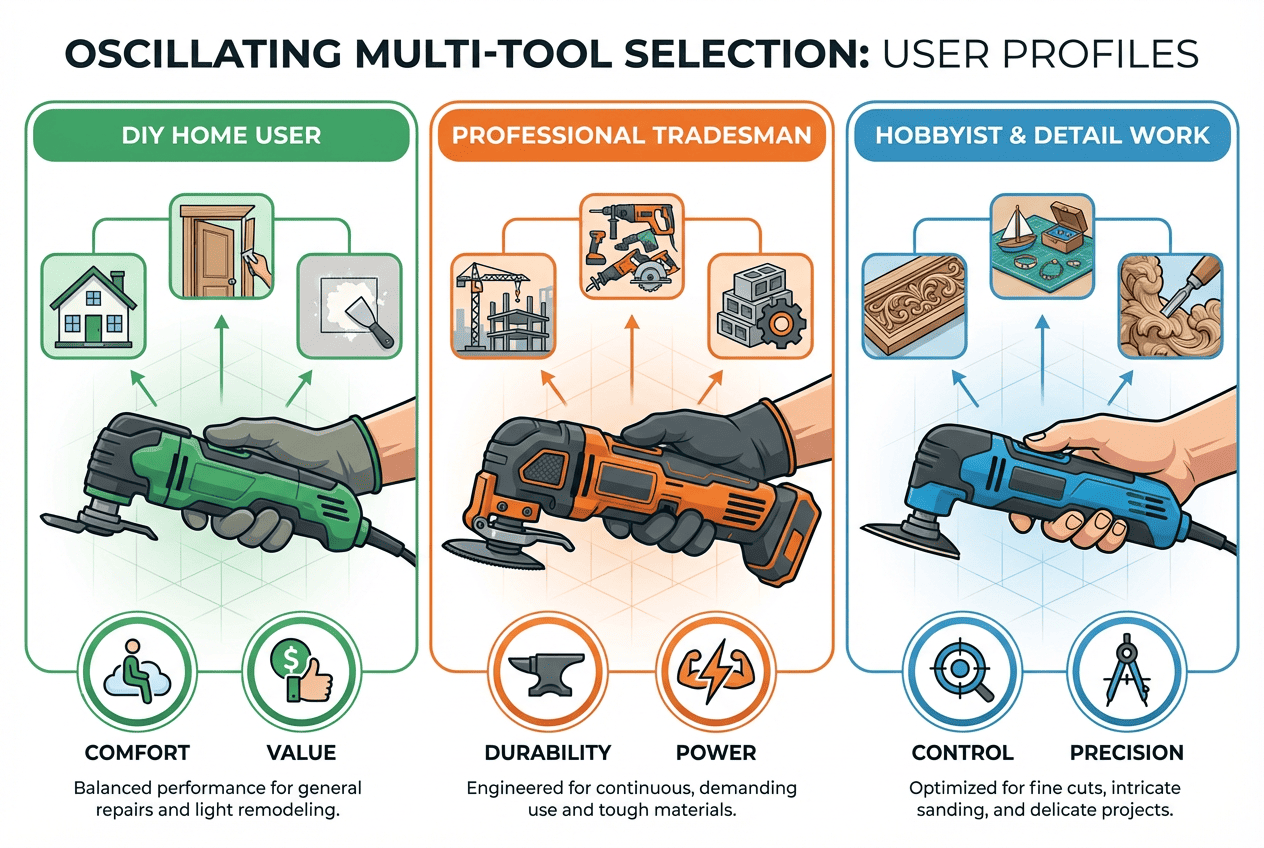
Before selecting any tool, you must assess your needs to see which tool ultimately suits you. There are three broad categories of users:
a. DIY-oriented home enthusiasts;
b. professional tradesmen;
c. hobbyists who concern themselves with the finer details of work.
DIY Home Users
You’ll often, you’ll often have a DIY project at home where the oscillating multi-tool comes in handy for trim designs in and around the door frames, cutting holes in drywall patches, trimming skirting boards, adhesive or caulk removal, and polishing around tight spots.
You don’t need the most expensive or most powerful, but rather an average-priced range tool with variable-speed control, comfortable handling, and a weight you can wield without any strain.
At this skill level, cordless models can offer less value for handyman work, though corded models provide good value in terms of value if power outlets are close by.
For Professional Tradesmen
Suppose you are a carpenter, a plumber, an electrician, a tiler, or a general contractor. In this line of work, both longevity and performance matter. You really want the Best oscillating tool for professionals that can go on working with the motor for a long time without overheating, plus be able to withstand dust, knocks, and inevitable transport mishandling. Professional models usually have high-grade motors, dust bags, tougher casings, and better cooling compared to cheaper models sold in DIY stores.
Hobbyists & Detail Work
The applications of an oscillating multi-tool in detailed work differ a whole lot-consider murals, toy dolls, antique furniture, fine woodwork, model cars, and ornate carvings. You are most likely doing joint cleaning, sanding some part of the piece, shaping its outer dimensions, and detailing some things.
Control is far more important here than raw power. The preference should be for small power, little weight, less vibration, and already good speed control. A good blender also comes in handy for such tasks.
Budget, Value & Long-Term Costs
It’s easy to think cost only comes with an up-front price, but consider all the little accessories you might need to get, replacing a worn-out tool, and it is quick to see the actual figures. Giving the problem a big solution before it actually occurs will bring the buyer much closer to contentment.
Tool Expense and Upfront Cost
Entry-level tools might work every once in a while for light work. Their affordability and extra features entice people into buying them. However, when subjected to heavy usage, they end up shaking much during operation, are not really strong, and tend to break when forced to carry heavy loads.
If you know you will be using an oscillating multi-tool regularly, opt for the higher-end models. It’s entirely about the cost of replacement parts and consumables. Tools usually came with blades and sanding sheets, which have to be replaced because they wear down with use. In the long run, you could spend more on accessories than on the tool itself: most people think of good deals with cheap blades, while, in fact, these dull quickly, overheat, or break.
Buying selectively ensures lower costs while achieving desirable, simple, general results: multipacks of blades and sanding sheets that are used most often and should be purchased; specialty add-ons should be added as needed for work. In this way, your kit is streamlined, and you aren’t paying for unnecessarily large mixed sets, including pieces that you may never use.
Examining Warranty and Support
A good warranty and support mean an honest brand will want its tools to last, while you also check how many years of cover you get, and whether it covers the motor and key components.
Support matters too. It is always good to know there are spare parts, someone to consult about problems, or the possibility of sending a tool for repairs if needed. For example, brands like MaxXT-Tech, which offer after-sales support, are easier to keep for a long time.
MaxXT-Tech: Smart Power for Every Project
MaxXT-Tech designs oscillating multi-tools that hit the sweet spot between smart engineering and real-world practicality. Their DIY-friendly models keep things simple, with comfortable grips, intuitive controls, and enough power for everyday cutting, sanding, and repairs. For pros, MaxXT-Tech steps it up with tough housings, stronger motors, and fast, reliable accessory changes built to survive jobsite abuse. With broad accessory compatibility and ergonomic design across the range, MaxXT-Tech gives both homeowners and tradespeople a precise, durable, and genuinely enjoyable tool to work with.
FAQs
Do I need a corded or cordless oscillating multi-tool?
For the most common kind of work, you will not go wrong using a corded multi-tool, which is also simple and reliable, and a great value most of the time, as long as power points are nearby. And if you are working in confined spaces, then cordless tools are the best to use.
Which wattage is best for beginners?
You should always go with less power if you are a beginner. Corded tools in the mid-range and 18 or 20-volt cordless tools from reputable brands are best for a beginner, for they deliver enough power for most jobs, yet not too overpowering or hard to control. Apart from that, variable speed and a comfortable grip should also come into play.
What are the best blades to start with in general household jobs?
A couple of sizes of wood-cutting blades, one bi-metal blade that can handle nails or screws, and a sanding pad with sanders. This easiest kit will tackle most of the common household chores while giving you a good idea of what you will really use to buy more.
How do I prevent vibrations and fatigue from long work?
Look for a very low vibration tool, well-balanced with power. Use sharp and high-quality accessories and allow the tool to do its job; do not push it. Hold onto the tool, but not with tension, and make little breaks during long-term work to enable your hand and forearm muscle structures to recuperate. These little habits will turn a mountain of comfort.
How to know when it is time to restock blades and sanding pads?
Normally, when blades cut too slowly, burn the material, or seem round or toothless, then it’s time to change. Sanding sheets should be replaced if they gets clogged up quickly and prevent any material from being removed. The easier it is to accomplish, the safer and cleaner the work will be, the more accessories one can use.
Abschluss
The most intelligent tool, if one must buy, is an oscillating multi-tool because it cuts, sands, scrapes, and trims in areas where other tools become sweaty. The trick is in choosing an appropriate model that would suit your projects, your hands, and your wallet.
Before you know it, with powerful ergonomics, an intelligent accessory system, and a good brand, the tool will have become comfortable to use and earned its place in your kit. Its occupational versatility is such that it is appealing to DIY homeowners, professional tradespersons, and detail-obsessed hobbyists. They can all use it as their go-to tool when in need.
 German
  English
  Arabic
  French
  Portuguese
  Russian
  Spanish
  Turkish