
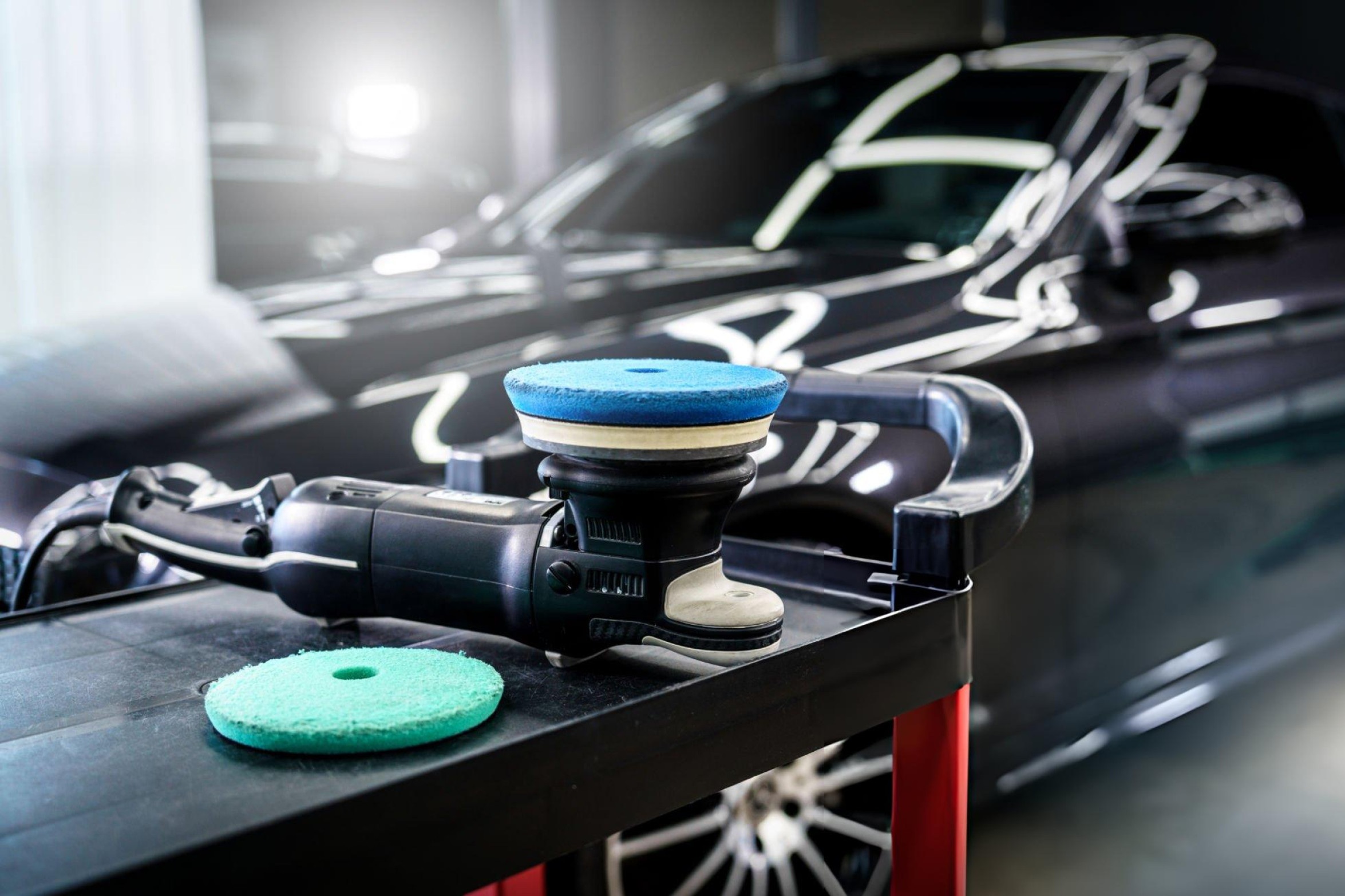
Selecting a polisher that feels good for you is an uphill task. Nowadays, it is becoming increasingly dependent on speed, safety, and learning path, and this is where the suitability of the respective polishers can only be judged based on the skill of the user, the paint condition, and the target goals. This article will give a small insight into car polishers, their various applications, pros and cons, and finally deliver a recommendation on the safest and most effective one.
Fundamentals of Car Polishers
It is helpful to know what a polisher actually does and how this process differs. Once you get a handle on the basic principles behind polishing, these tools will feel much less daunting.
Functions of Car Polishers
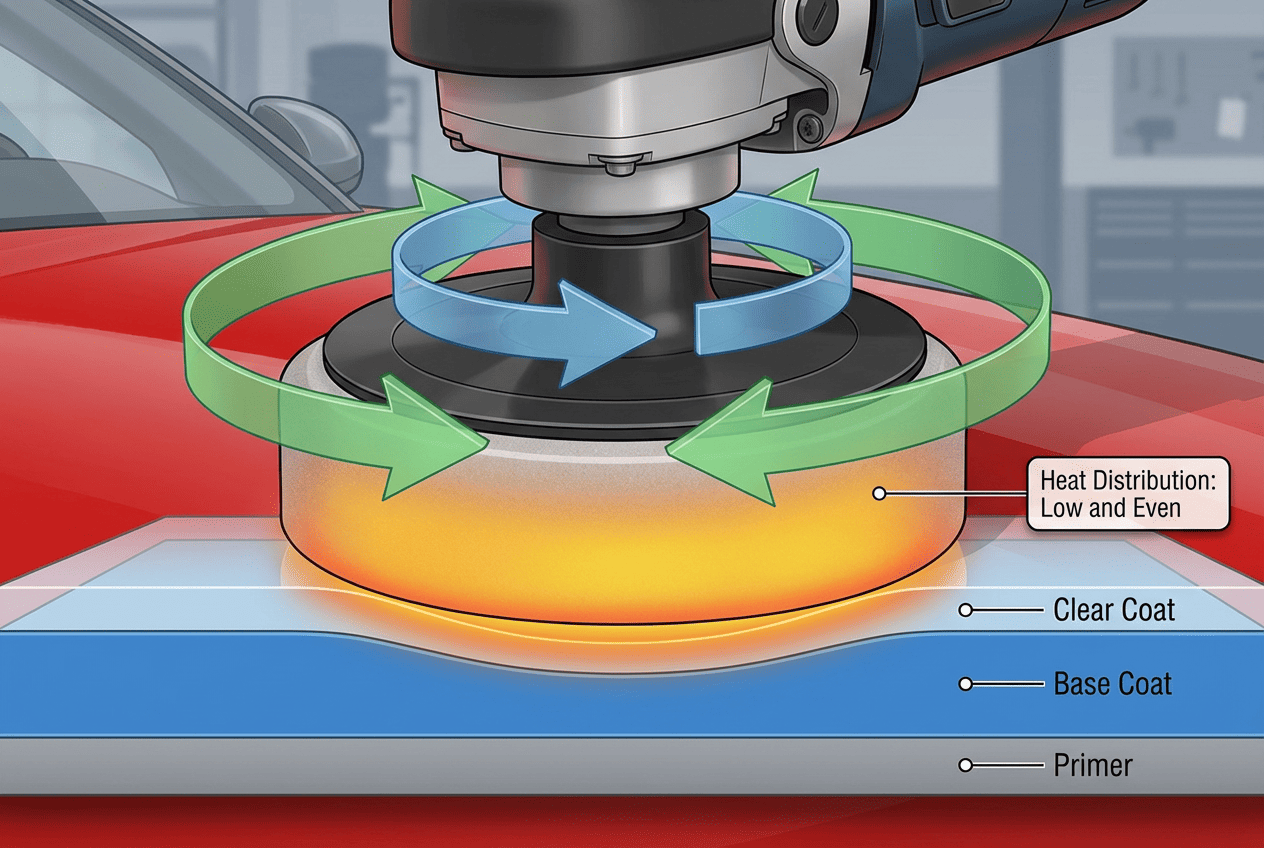
A car polisher is a machine designed to refine and correct your paint; it doesn’t just shine it up for a short while. Polishing is different. It actually removes a very thin layer of clear coat to level out surface defects. By carefully cutting away a tiny amount of clear coat, a polisher can reduce or remove haze, light scratches, swirl marks, oxidation, and water spots. You are basically making the paint smooth so that light reflects more evenly. That is what creates that deep and mirror-like finish people are in love with.
Key Concepts: Cut, Speed, and Control
Cut refers to how aggressive your combination of polisher, pad, and compound is. Strong cutting combos remove defects faster, but they also remove clear coat and should therefore be handled with care.
Speed is another key factor. In machine polishers, speed is expressed in RPM (for rotary) or in OPM, i.e. oscillations per minute (for dual-action machines). The higher the speed, together with some pressure, the higher the correction, but it also increases heat and risk.
Control and consistency trump power. It is much more effective to work with a less powerful machine that feels comfortable in your hand than one that you are unable to control with any precision. Smooth and even passes made with the correct combination will always prove superior to a heavy-handed execution with the incorrect technique.
Manual vs. Machine Polishing
There are different types of polishers. Hand polishing does have its limitations. Some glossing, hiding of some very light marks, and neatening product application can be achieved, but it is a question of speed and correction with regard to which machine can win for sure. Your arms get tired due to the long application period.
Machine polishers, when used appropriately, can work far quicker, much more efficiently, and consistently. The machine maintains a consistent speed and pattern of pad motion, something which is tough to control by hand. Machine polishing can be safer than manual scrubbing.
Major Types of Car Polishers
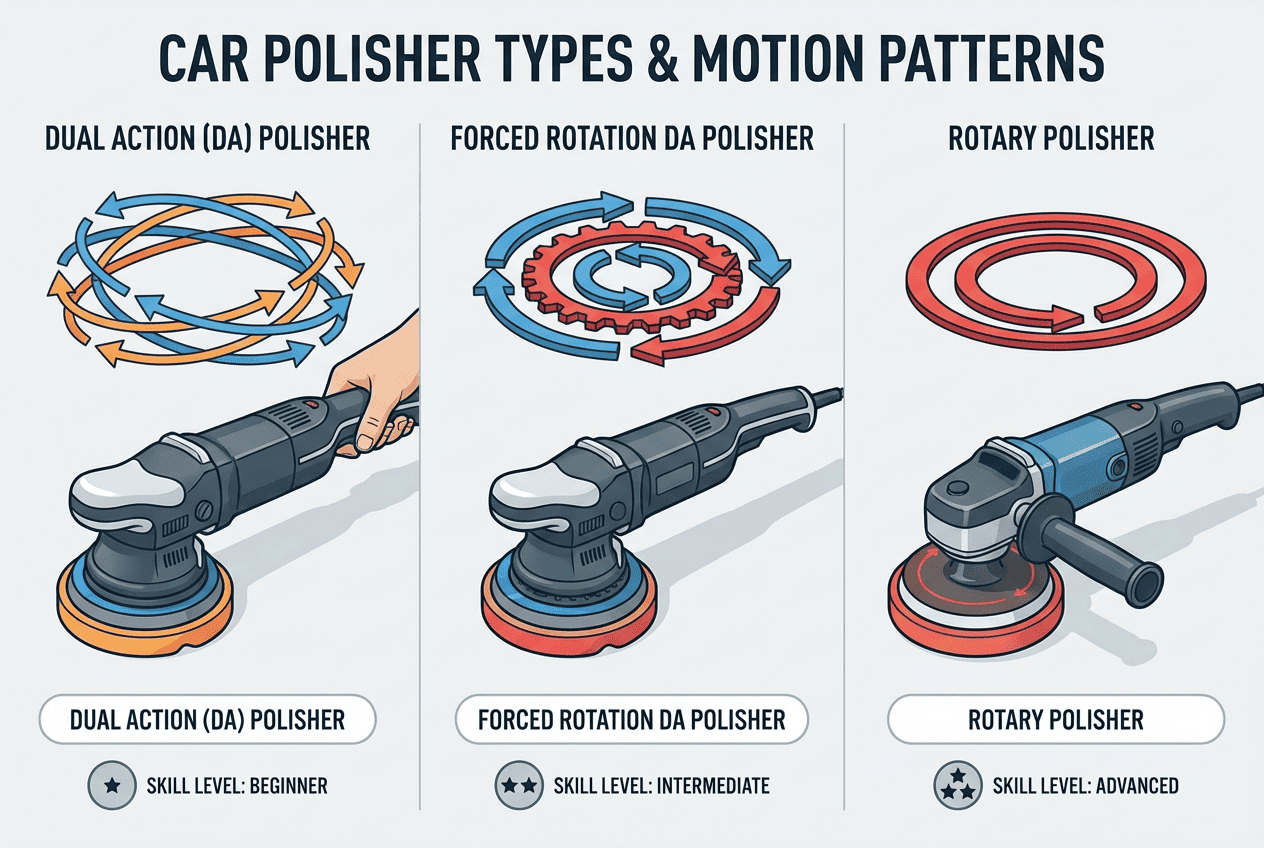
For paint correction purposes, these polishers are divided into three main family categories:
- Dual action (DA) or random orbital buffer,
- Forced rotation dual action,
- Rotary polishers.
Each one has certain special advantages and disadvantages.
Dual Action (DA) / Random Orbital Polishers
The dual-action polisher is the best car polisher machine. It comprises of two motions working at the same time; the pad spins in a circle as well as oscillates in a smaller orbit. This “random” motion prevents the pad from riding in one place and generating excessive heat.
DA or Random orbital polishers are generally considered the safest for a beginner and, if used for a bit more than occasional use, for a budding enthusiast, with far lesser chances of burning paint or leaving nasty buffer trails.
Product application, light to medium correction, application of finishing polishers and waxes or sealants are within the skill set of DA polishers. Pros are clear: low risk of burning paint, easy learning curve, and enough power to really change most daily driver cars. This is what really makes a DA polisher the best first machine for most people.
Mechanical Forced Rotation Dual Action Polishers
These forced dual-action mechanical polishers bear some similarities to a typical DA, but their operations are somewhat different from those of a typical DA. The spindle drive system enables the pad to continue moving against various resisting forces, including pressures coming from an invariably stiff grip of the user’s hands or canvas with curved hands.
On its own, the mechanism adds a slight level of correcting ability compared to a totally free-spinning DA, and just enough of the safety feel from a dual-action motion. Less aggressive than rotary polishers, more aggressive than free-spinning polishers.
Forced polishing is for the more advanced hobbyists and professionals who really need a great cut action for tough defects, but still want to retain a safety net from old-school rotary tools. Simply put, this is an upgrade when you find that your DA cannot address severe swirl marks and etching.
Polisseuses rotatives
A rotary polisher has only a direct, simple spinning motion, like the angle grinder with a polishing pad. In this way, polishing pads revolve around a fixed axis without oscillating with the movement. Such an operation is really hard to use, and it cuts down heavy damage with speed.
They are best suited for bodywork shops, with automotive buffing machines and those pro detailing type of guys who do serious paint correction after repainting or sanding.
The negative thing is that it is risky. The rotary machines generate much heat, especially on edges and high spots, and they are bound to create hologram effects or burn clear coats when used improperly. This requires an advanced level of proficiency, plus patience and knowledge of paint. For these reasons, it is advisable to provide a rotary machine only to advanced users or professionals who are ready to practice carefully and sharpen their technique.
Matching the Polisher to Experience
One thing you’ll notice about polisher types is that one machine can be perfectly safe with one person, while with another, it would be dangerous. The other consideration is that while polisher safety is a huge factor in choosing a tool, you should also focus on your painting-handling skills.
Total Beginners
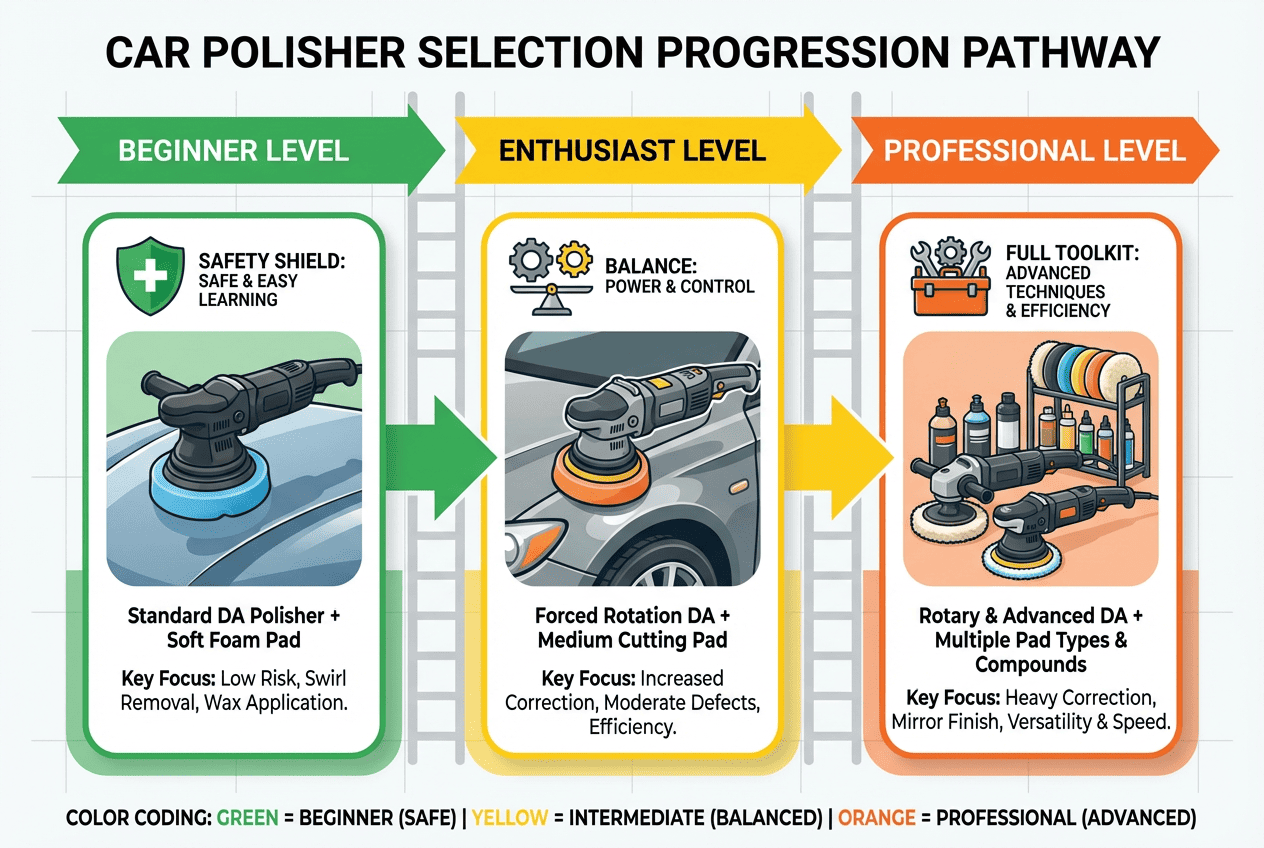
If you’ve never used a machine to polish a vehicle, then a dual-action (DA) polisher is almost always the best bet. Movement patterns are easy, and the damage risk is very low, especially when combined with more gentle pads and polishers.
That DA should have low vibration, an excellent grip, and not be heavy. Those particular features allow the machine to be held steady while focusing on your technique.
Most of all, beginners need to learn how to improve the shine and refine light defects while protecting the car rather than chasing deep scratches.
Enthusiasts with Some Experience
If you’ve been through it before and understood all the basics, it’s probably now a good time to start looking for a more powerful machine that can correct. This is when you begin investigating stronger DA polishers with more throw or forced rotation dual-action mechanisms.
Of course, this must be done safely but effectively. At this stage, you can also set up a system that matches your polisher to a limited number of pads and compounds chosen for a specific purpose, i.e., one cutting combo and one finishing combo. It will produce fine results.
Professional Detailers
Most of the time, professional detailers will have a range of polishing machines. A fairly standard combination is a conventional DA for finishing work and safer correction, and a rotary for heavy-duty cutting work, spot repairs, or really requiring the most speed. Some will also usually want to have a forced rotation DA as a middle tool.
But pros need polishers that stand up to hours on end and daily use while also being consistent in performance; therefore, durability, cord quality, trigger feel, and reliability become just as important as cutting power.
For the expert people, mastering the technique is non-negotiable. Knowing when to pull a certain machine, how to control heat in the paint finish, and how to finish down without holograms saves time, reduces comebacks, and protects the business’s reputation.
Budget, Value and Brand Decision
Polishing machines are abundant, from the very cheap to those bordering on the seriously expensive. Knowing what you get for various price levels helps you avoid wasting funds or overbuying.
Entry Level vs. Professional Polishers
Generally speaking, entry-level polishers provide just enough power for light-to-moderate correction, basic variable speed, and reasonably good ergonomics. For someone who polishers their own car once or twice a year, a simple DA is the best car polisher for beginners.
Professionals tend to sit up high on the price scale, where better build quality, smoother operation, stronger motors, and more refined control become factors. If you are a detailer, planning to polish several cars on a regular basis, or just want that extra bit of smoothness and confidence, then it pays to invest in the higher-end tools. However, if you are likely to be working on your own car only occasionally, then a good entry-level or mid-range DA offers the best value.
Long-Term Costs: Pads, Products and Maintenance
The machine itself is only one part of the cost. Pads wear out, compounds and polishers get used up, and everything needs to be maintained. You will be spending money on things like pads to replace foam or microfiber pads, buying more product, and cleaning your gear.
If you let them get clogs of dried compound or too hot, they will live a shorter life. A little careful maintenance will save you a lot of money in buying new pads.
Using quality tools and accessories might cost more up front, but they usually save time and frustration. Good pads and polishers usually cut better, finish cleaner, and require fewer passes to obtain the same result.
Brand Reliability and Support
Purchasing the polisher from the manufacturer with a good reputation and history is worth it. Trusted brands have better quality control, clearer instructions, better warranty terms, and even the availability of parts.
From reviews, detailing forums, and local detailers’ communities, you can draw information regarding real performance. Most people will mention any machines that have early failures or that feel rough and unbalanced.
Le MaxXT-Tech polishers are another good illustration of a user-oriented approach. The motto of durability, easy-to-use controls, and ergonomics for comfort over long sessions, which comes with dependable post-sale support, assures you even more to trust in the design philosophy behind holding your investment over time.
FAQ
Can I burn my paint with a DA polisher?
Possible, but highly unlikely, with generally safe speeds, sensible pressure, and pad movements. Any significant damage would involve extremely kicking the machine on one spot. This is, of course, why DAs are so popular-first machine.
Do I really have to polish and wax or seal my paint?
Polish is made to correct and refine the paint, while wax or sealant serves to protect. After polishing, the clear coat is left a bit more exposed and cleaner; hence, a protective layer would help. Ideally, you polish as you need, then throw on some wax, sealant-or coating depending on the desired maintenance of your results.
How often should I polish my car with the machine?
There isn’t any one clear answer, but for most daily drivers, heavy correction shouldn’t happen more often than once every few years anyway. However, some light polishing can be done for gloss enhancement fairly often, as long as one uses gentle products. The main thing is not to over-retreat your clear coat.
DA or rotary, what do you find better for black cars?
For most considerations of black paint, DA seems a better option. Every single inconsistency is recorded into that paint, every single hologram. The DA helps you finish down clean with less risk. Rotarys deliver some brilliant feedback on the only differentiator is that they require advanced skills to be able to avoid holograms and marring.
Conclusion
The best polisher for car are never really the most powerful, nor the most expensive. The BEST is one that suits the experience level of the user, the condition of the paint, as well as the expectation. For most drivers and fledgling enthusiasts, the ideal machine is a dual-action polisher, the safest and most versatile approach for beginners.You must take time to learn the basics and allow results to improve over time. When done appropriately, machine polishing turns car care into an enjoyable and rewarding experience of ownership, rather than a boring task.
 French
  English
  Arabic
  German
  Portuguese
  Russian
  Spanish
  Turkish