
Key Takeaways
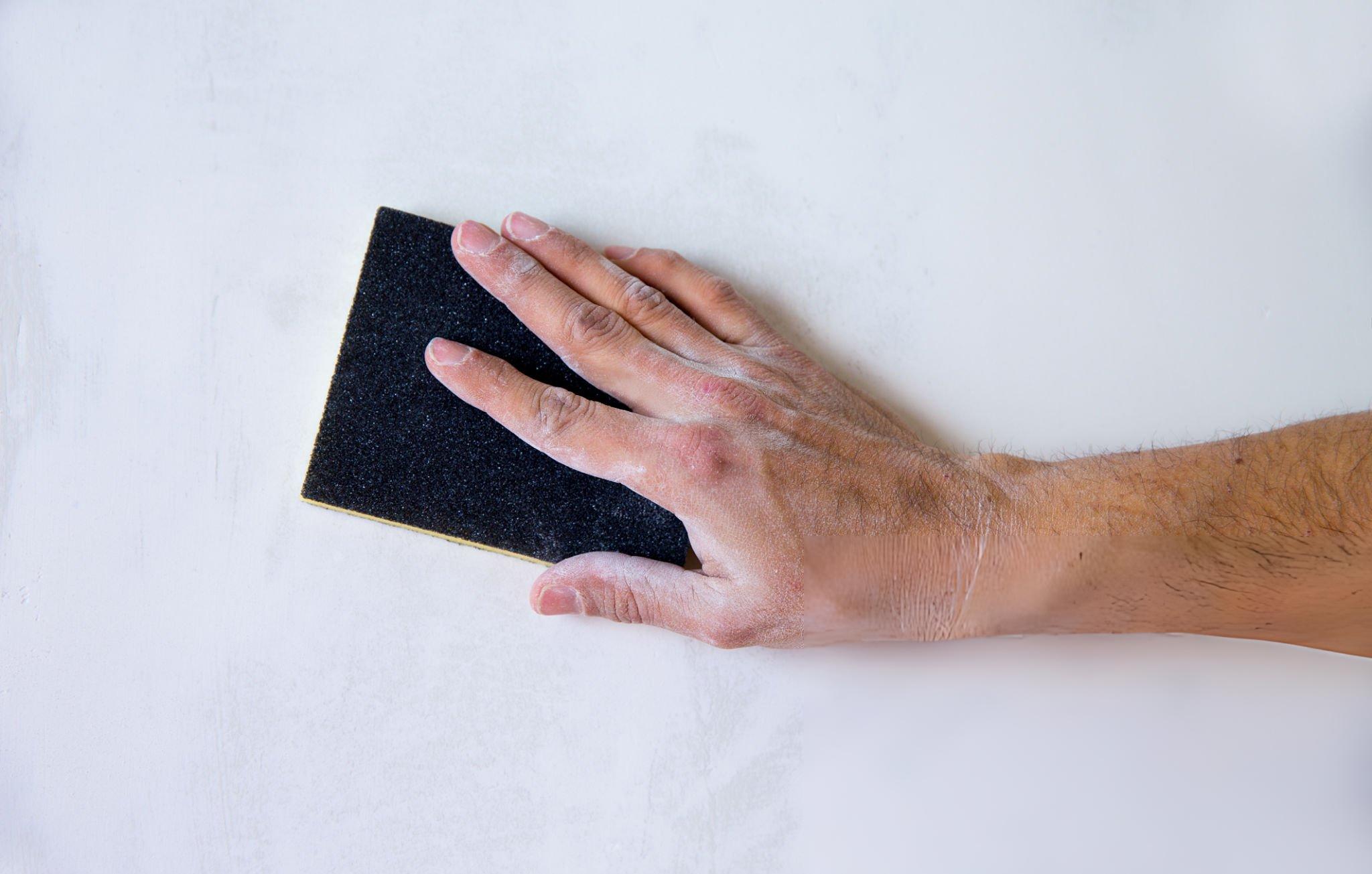
- Drywall sanding sponges and drywall sandpaper are both essential when sanding drywall, but they serve different purposes.
- Drywall Sandpaper is best for removing thick joint compound fast.
- Because of their flexibility, drywall sanding sponges are best for corners and awkward shapes.
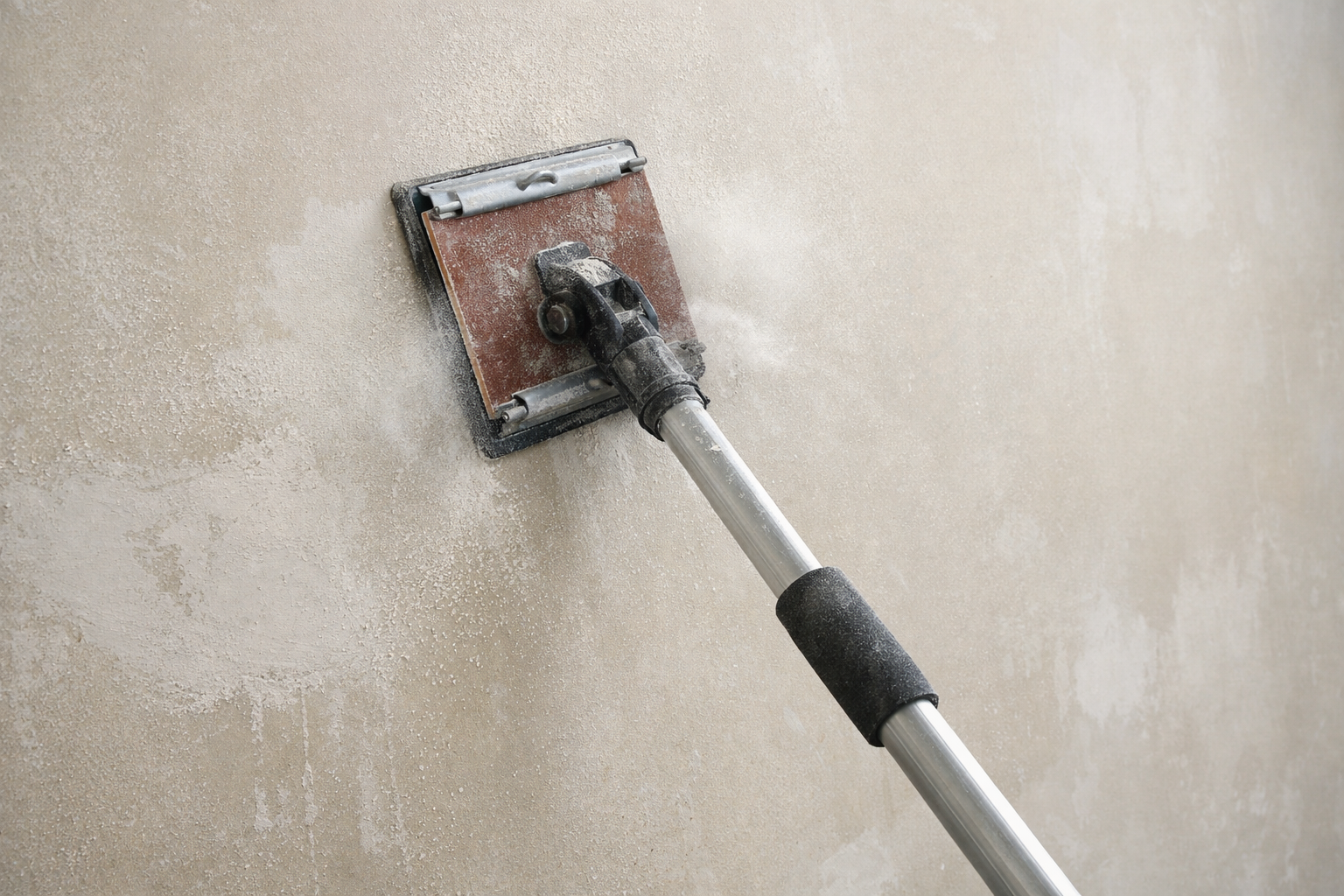
- Sandpaper can be used with electric drywall pole sanders.
- Sanding sponges are ideal for wet sanding to reduce dust.
- Use sandpaper when you need to level large surfaces and sanding sponges for finishing.
This sanding guide is for anyone who wants to be confident that they understand the key differences between drywall sanding sponges vs sandpaper and how to use each one effectively.
Sanding Sponge: What It Is and When to Use It
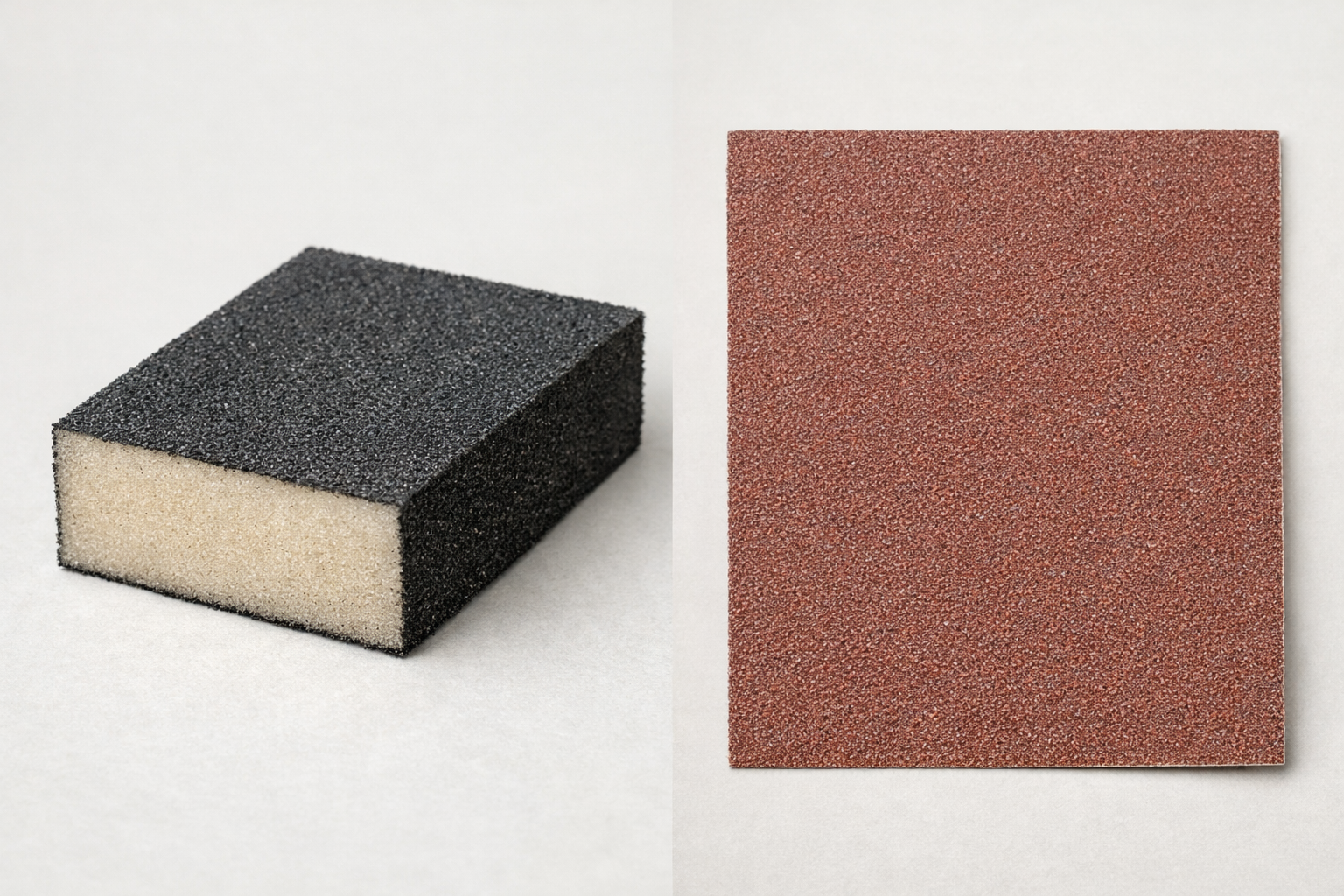
A drywall sanding sponge is a piece of foam covered with abrasive material (aluminum oxide or silicon carbide) on one or more sides. Some sanding sponges feature different grits on each side. The flexibility of the foam allows the sanding sponge to conform to the shapes being sanded, making the tool ideal for sanding odd shapes.
Drywall sanding sponges can be used for dry and wet sanding. Wet sanding is beneficial from a health perspective because it reduces the risk of inhaling toxic dust particles.
Types of Sanding Sponges
The following three drywall sponges differ in design, but they all deliver a professional finish. They are easy to clean and reusable and all of them produce a dustless experience when used wet.
The standard drywall sanding sponge has a coarse side and a fine side. You can use the coarse side for regular sanding, and the fine side for finishing.
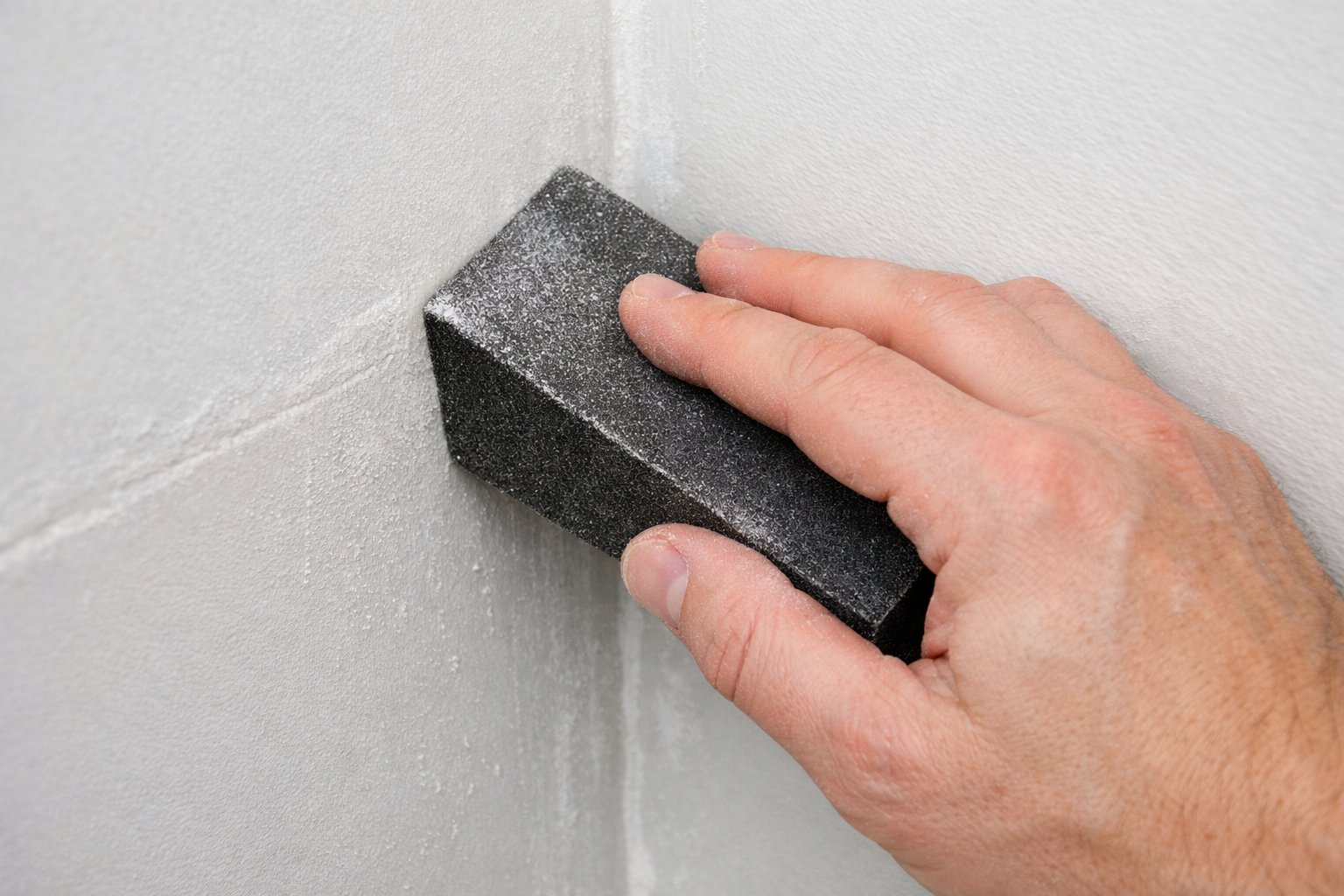
The angled drywall sanding sponge has an angled edge that makes sanding corners and edges easier.
The premium drywall sanding sponge features multiple layers of durable foam that keep their shape while sanding effectively over extended periods.
When to Use a Drywall Sanding Sponge
If you have ever faced a small closet, a stairwell, or a spot where two walls meet a ceiling, you will know how challenging it is to achieve a smooth and even sanding finish in these spaces. This is where a sanding sponge comes in handy – it makes smoothing these hard-to-reach areas considerably easier.
A sanding sponge conforms to the surface that you are working on, whether it’s a molding, an edge, or a tight corner. Being a soft and pliable tool, it is also useful for light touch-up work and finishing touches.
Advantages
- Versatility – can be used for both dry and wet sanding.
- Flexible Design – can be used to sand contours, edges, intricate details, and hard-to-reach areas.
- Mixed-use – various grits enable multiple sanding tasks, from coarse grits for heavy material removal to fine grits for fine finishing.
- Dust Control – produces less dust than sandpaper, protecting respiratory health.
- Cost-effective – can be washed and reused many times.
Sandpaper: What It Is and When to Use It
Drywall sandpaper is a thick, flexible paper coated with an abrasive material (like aluminum oxide, silicon carbide, or sand) on one side. In addition to paper sheets, sandpaper is also attached to wooden blocks, sponges, and power tool sanding disks.
Sandpaper comes in a range of grits. The grit indicates the size of abrasive particles on the paper – low numbers (40–60) indicate a coarse grit, and high numbers (180–3000+) indicate a fine grit. Higher-grit sandpaper is used during the last stage of a drywall sanding project to prepare the surface for paint. It’s essential to know what the grits of sandpaper are, so you’re sure you use the right grit for every sanding project stage.
When to Use Sandpaper for Drywall
Sandpaper is useful at every stage of a drywall project, provided you match the sandpaper grit to the task at hand.
Sandpaper, used manually or attached to a block or power sander, is typically used for heavy material removal and smoothing large, flat surfaces. Attached to a block, the added rigidity makes it easier to apply even pressure over large surfaces, such as walls.
Advantages
- Available in a wide range of grits: sandpaper in a wide range of grits from coarse to ultra-fine.
- Cost-effective and widely available: sandpaper is inexpensive and easily available.
- Compatible with sanding tools: sandpaper sheets can be attached to pole sander disks to speed up the work.
When Sandpaper Is the Better Choice
Drywall sandpaper is better than a drywall sanding sponge when:
- You need to sand large, flat areas.
- You need to remove large amounts of dried, uneven joint compound.
- You want to achieve a flat surface with perfect tapering.
- You have a high volume of sanding work. Sandpaper attached to a pole sander is faster and more efficient for walls or ceilings than a drywall sponge.
Choosing the Right Grit for Drywall Sanding
Common Grit Ranges and When to Use Them
Choosing the correct grit is essential when preparing drywall for paint. Keep in mind that low grit numbers refer to coarse grit that removes material fast, and higher-grit sandpaper is best for perfectly smoothing surfaces.
A Handy Grit Summary
- Coarse grit (80–100 grit) for removing heavy compound build-up or leveling uneven areas.
- Medium grit (120–150 grit) for general drywall sanding of dried compound.
- Fine grit (180–220 grit) for final finishing and smoothing before priming or painting.
Sanding Sponge Grit vs Sandpaper Grit
The grit ratings for drywall sanding sponges are similar to those for sandpaper, but they are not categorized in numbers; they are typically categorized as medium, fine, and very fine. Because of the flexibility of a sanding sponge, the various grits may not perform the same. For example, a 120-grit sanding sponge may produce a somewhat finer result than rigid 120-grit sandpaper.
For help to make the perfect choice, consult the table below.
Sponge Grit and Sandpaper Grit Compared
| Sandpaper Grit | Typical Sponge Equivalent | Common Use |
| 80 –100 | Medium | Removing excess joint compound |
| 120 –150 | Fine | General drywall sanding |
| 180 –220 | Very Fine | Final finishing before painting |
Common Drywall Sanding Mistakes and How to Avoid Them
Using the Wrong Grit
For instance, using a coarse grit towards the end of the sanding project can remove too much compound and if you work with a fine grit in the beginning of the project, it may take too long to remove enough material.
Excessive Sanding
Sanding too much can damage the drywall paper, which can be difficult to fix. Stop sanding at intervals to check your work for evenness before continuing.
Not Waiting For the Mud to Dry
Sanding too soon means whatever tool you use won’t work properly because the compound is too wet to sand. Make sure the mud is completely dry before you start.
Using Too Much Force
Heavy pressure inevitably damages the compound and the wallpaper. Focus on letting the sandpaper do the work and use light, even pressure.
Skipping Grits
Skipping from very coarse to fine-grit sandpaper leaves scratches that show after painting. Avoid scratches and ensure a smooth finish by moving gradually from a coarse to a higher-grit sandpaper.
Failing to Feather the Edges
If you don’t feather the edges, you’ll have clear lines where the compound meets another surface. To create a smooth finish that shows no lines between different parts of the work, feather the compound edges using a fine-grit sandpaper.
Health and Safety Considerations
Sanding drywall generates hazardous airborne particles that necessitate proper safety precautions to prevent breathing issues. The Occupational Safety and Health Administration (OSHA) recommends using dust control methods, such as sanders with dust collection systems, proper ventilation, and appropriate personal protective equipment (PPE) to limit exposure to dust particles during tasks like drywall sanding.
PPE should include fitted clothing, or overalls, safety goggles, a dust mask or respirator, and gloves to limit exposure to harmful dust particles.
The National Institute for Occupational Health and Safety (NIOSH) recommends that construction workers use wet sanding methods whenever possible and ventilation to cut dust exposure.
Sanding Sponge vs Sandpaper: Key Differences
| Feature | Sanding Sponge | Sandpaper |
| Flexibility | Conforms to different shapes | Best for flat surfaces |
| Durability | Can be washed and reused | Wears down, must be replaced often |
| Dust | Can control dust with wet sanding | Generates more dust |
| Purpose | Ideal for detail work | Works well for large areas |
| Cost | More expensive upfront, but lasts longer | More affordable, but deteriorates faster |
FAQs
Can you sand drywall with a sanding sponge pad?
Yes, you can. Sanding sponge pads are flexible abrasive tools used to finish drywall joints, sanding edges, and smoothing small patches that are difficult to sand with rigid sandpaper.
When should you use fine-grit sandpaper for drywall?
Fine-grit sandpaper (150 to 220 grit) is best for the final stages of a drywall sanding project when you’re getting the surface ready for primer and paint.
How long does it take for drywall to dry?
Drywall mud takes at least 24 hours to dry. You can use fans and dehumidifiers to help with the process.
What tool is best for heavy-duty continuous sanding?
An air sander, which uses compressed air from a compressor to drive an abrasive disc, is best for this purpose because it is lightweight, robust, and does not overheat.
Is it better to wet sand or dry sand drywall?
Wet sanding produces less dust and is safer for your health, but takes longer and requires more cleanup. Dry sanding is faster and works better for heavy material removal. Use wet sanding for final finishing or in occupied spaces; use dry sanding for rough work and large areas.
Conclusion
Both drywall sanding sponges and sandpaper are essential tools for sanding drywall. While sandpaper, especially in combination with an air sander, is best for quickly smoothing large wall and ceiling surfaces, the flexibility of a drywall sponge is ideal for sanding corners, edges, and small patches. Neither is better than the other; they serve different purposes. For this reason, many homeowners and contractors don’t think sanding sponge vs sandpaper, but sanding sponge and sandpaper.
MaxXT has a line of professional drywall sanding products to suit the needs of home improvement enthusiasts, private contractors, and bulk buyers. Contact our team today if you want to do business with a trusted drywall tools supplier.

 English
  Arabic
  French
  German
  Portuguese
  Russian
  Spanish
  Turkish