
Key Takeaways
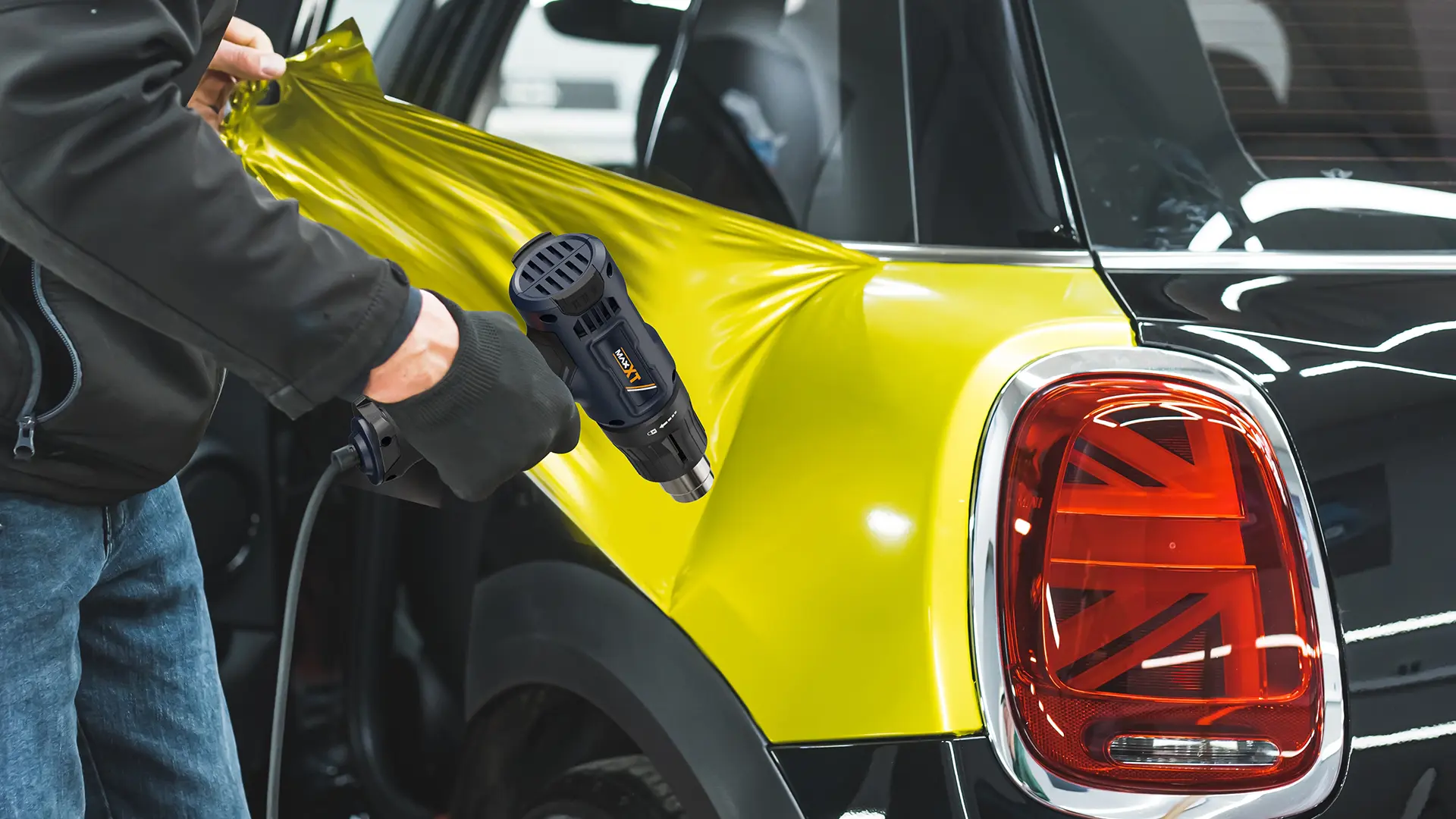
The global automotive wrap films market is projected at $14.84B in 2026, growing to $68.65B by 2034 at 21.1% CAGR (Straits Research, 2026) — creating sustained demand for heat guns among professional installers.
For distributors, the ability to diagnose “technique failure vs. tool failure” over the phone reduces unnecessary returns and positions you as a technical partner, not just a parts supplier.
The most common cause of wrap returns — edge lifting within the first week — traces directly to skipped post-heating, not defective tools. Knowing this one diagnostic question can save a sale.
Variable-temperature heat guns (50-600°C) address the broadest market, while dual-mode models serve dedicated application stations. Recommended stocking ratio: 60% variable, 25% dual-mode, 15% cordless.
The global automotive wrap films market is projected at $14.84 billion in 2026, growing to $68.65 billion by 2034 at 21.1% CAGR (Straits Research, 2026). As this market accelerates, so does demand for the heat gun — the primary tool required for every wrap installation.
Professional vinyl wrap installation requires a heat gun capable of sustained 300-600°C output with precise temperature control. The global market for wrap films is projected at $14.84 billion in 2026, creating a parallel equipment market where 60% of heat gun demand is for variable-temperature models ranging 50-600°C. Distributors who carry a mix of variable, dual-mode, and cordless heat guns capture the full spectrum from budget-conscious to premium buyers.
For distributors, this creates both opportunity and risk. Every new wrap shop needs heat guns, but every misdiagnosed tool complaint that results in a return eats into margin. The difference between a distributor who ships boxes and one who becomes a trusted technical partner is the ability to answer: Is the tool defective, or is the technique wrong?
MaxXT’s wholesale automotive heat gun lineup includes the dual-mode MHG1800, the variable-temperature MHG2000, and the cordless MDHG20V. This guide is a decision-making resource for distributors who need to understand heat gun technique well enough to advise customers, diagnose complaints, and stock the right inventory.
Why Does Heat Gun Technique Matter for Your Business?
The automotive wrap films market is projected at $14.84B in 2026, growing to $68.65B by 2034 at 21.1% CAGR (Straits Research, 2026). For distributors, more end-users buying heat guns means more potential returns when technique mismatches tool capability.
What this means for you: When a shop owner calls about bubbles or edge lifting, the real issue is often technique, not tool quality. The distributor who can diagnose “wrong temperature” vs. “wrong tool” keeps the sale. For wholesale inquiries, visit the MaxXT dealer program.
Professional wrap shops require proper heat guns — not hair dryers, which cannot sustain the 300-600°C output needed. Improper technique causes lifted edges, rework, and customer churn. Each failure generates a call to you. How you handle it determines whether the relationship strengthens or ends.
| Failure Cause | Reported Frequency | Dealer Action |
|---|---|---|
| Post-heating skipped or insufficient | Most common | Educate customer on post-heat step |
| Wrong temperature for vinyl type | Very common | Provide temperature reference table |
| Surface contamination (wax, oil) | Common | Upsell isopropyl alcohol + wipes |
| Low-quality or expired film | Occasional | Refer customer to film supplier |
| Insufficient cure time before element exposure | Occasional | Inform 48-72 hour cure window |
Source: MaxXT dealer network feedback, 2025. Represents reported patterns from distributor service calls, not a controlled survey.
What Temperature Should a Heat Gun Be for Vinyl Wrap?
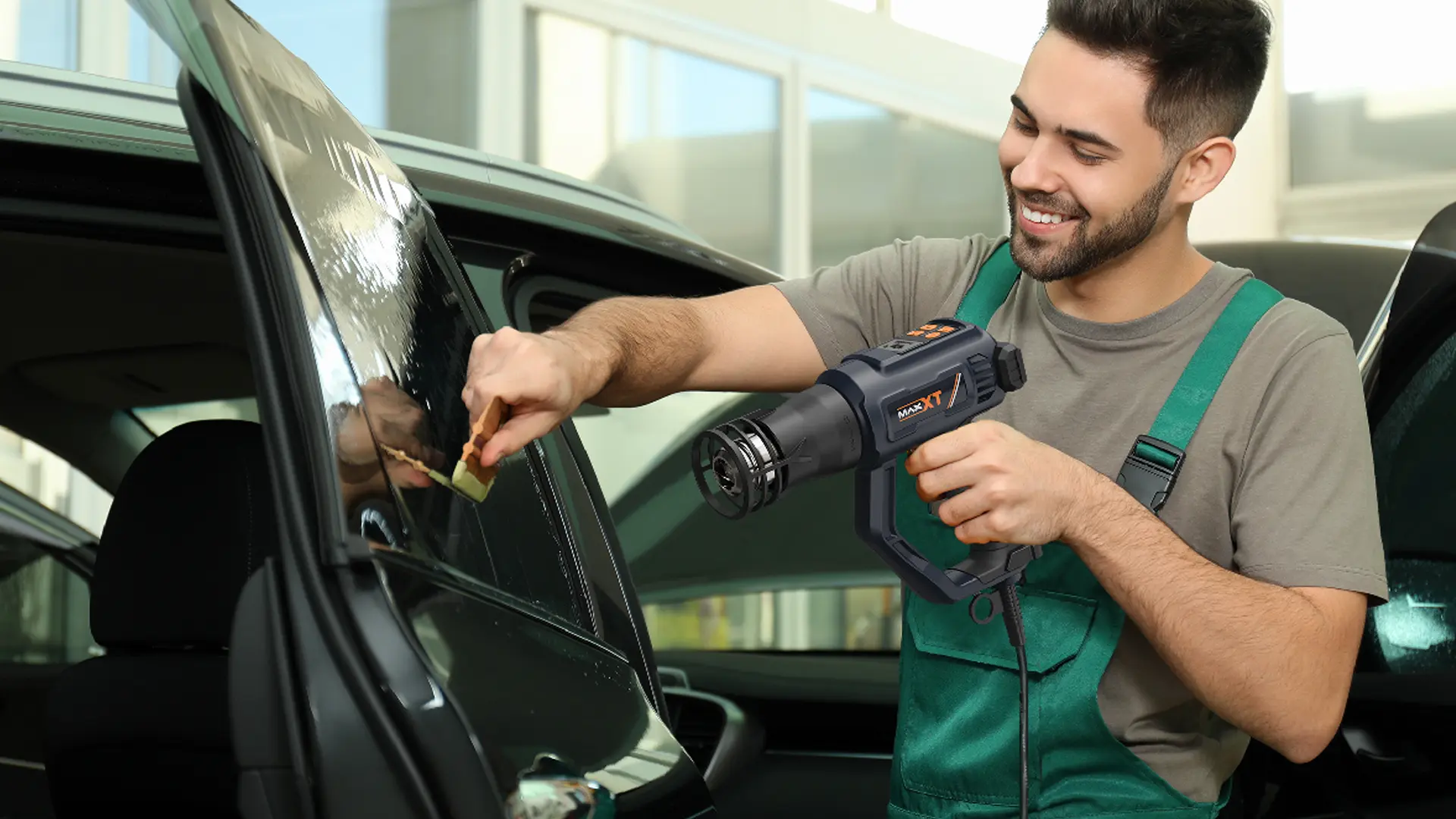
Temperature requirements split into two phases — stretching (90-140°F / 32-60°C surface temp) and post-heat activation (185-212°F / 85-100°C). Confusing these ranges is the most common source of wrap failure. These ranges are consistent with 3M and Avery Dennison technical specifications for cast vinyl wrap films (3M Wrap Film Series 2080 Product Bulletin, 2023; Avery Dennison Technical Bulletin #3.12, 2023).
What this means for you: When a customer returns saying the wrap “never stuck” or “lifted after a week,” ask whether they post-heated. This one question prevents unnecessary returns and builds your reputation as a technical partner.
| Vinyl Type | Stretch Temp (Surface) | Post-Heat Temp (Surface) | Risk Factor |
|---|---|---|---|
| Cast (gloss/matte/satin) | 95-140°F (35-60°C) | 185-212°F (85-100°C) | Low — most forgiving |
| Calendered | 120-150°F (50-65°C) | 200-248°F (95-120°C) | Medium — thicker, stiffer |
| Chrome / Metallic | 95-120°F (35-49°C) | 160-185°F (71-85°C) | High — permanent damage if overheated |
| Carbon Fiber / Textured | 100-130°F (38-54°C) | 175-200°F (79-93°C) | Medium — requires care |
Different film manufacturers may recommend slightly different ranges. Always default to the film manufacturer’s spec sheet. Ranges shown reflect 3M and Avery Dennison published specifications for cast, calendered, chrome, and textured films.
One critical point your customers need to understand: heat gun air temperature does not equal surface temperature. A gun set to 600°C (1112°F) does not mean the vinyl surface reaches 600°C — the distance, airflow, and sweeping speed all affect actual surface temperature. An infrared thermometer is the only reliable way to verify. The MaxXT MHG2000 variable-temperature heat gun offers precise 50-600°C adjustment, making it easier to dial in the right output for each application. The ideal installation environment is 65-80°F (18-27°C) ambient with below 50% relative humidity (3M Wrap Film Series 2080 Product Bulletin; Avery Dennison Technical Bulletin #3.12).
Vinyl wrap temperature control splits into two distinct phases: stretching at 90-140°F (32-60°C) surface temperature and post-heat activation at 185-212°F (85-100°C). These ranges are consistent with 3M and Avery Dennison technical specifications. Confusing these two ranges accounts for the majority of wrap failures, as post-heating activates the pressure-sensitive adhesive and prevents edge lifting within the first week of installation.
How Does Installation Technique Map to Your Customers’ Biggest Problems?
Most “defective tool” complaints trace back to one of five process gaps: surface prep skipped, heat applied before positioning, temperature wrong for the film type, adhesive not post-heated, or insufficient cure time. Each maps to a specific return reason you will hear from your customers.
What this means for you: This section is designed to be shared with your customers as troubleshooting guidance. But for you, the value is in the mapping — for each stage, we identify the most common complaint, the tool spec that contributes to or prevents the problem, and what you can ask to diagnose the issue over the phone.
| Stage | Customer Complaint | Diagnosis Question | Dealer Action |
|---|---|---|---|
| Surface Prep | “Wrap won’t stick” | “Did you wipe with alcohol before applying?” | Upsell isopropyl alcohol + lint-free wipes |
| Heating | “Bubbles in the wrap” | “Did you heat the film before or after laying it?” | Recommend dual-mode gun (MHG1800: 400/580°C) for simple control |
| Stretching | “Fish eye / overstretch marks” | “Were you using a sweeping motion or holding still?” | Recommend guns with adjustable airflow (300-550 L/min) |
| Post-Heating | “Edges lifting after 1 week” | “Did you reheat the edges to 185-212°F surface temp?” | #1 cause of wrap returns — technique coaching saves the sale |
Common issue from MaxXT’s dealer network: Customers calling to say “the heat gun stops working.” In approximately 80% of these cases, investigation reveals the thermal protection switch was triggered by blocked air intake vents, not a product defect. A quick verbal check — “Was the gun sitting on a soft surface or did you cover the vents?” — resolves most complaints without a return.
Dealer Diagnostic Flowchart: Is It the Tool or the Technique?
Customer says: “The wrap won’t stick / edges are lifting”
Ask #1: “Did you clean the surface with alcohol before applying?” → If no, technique issue (contamination). If yes, proceed.
Ask #2: “Did you post-heat the edges to 185-212°F?” → If no, technique issue (skipped post-heat — #1 cause). If yes, proceed.
Ask #3: “Did the gun shut off during use?” → If yes, check air intake blockage. If no, proceed.
Likely outcome: Technique issue in ~80% of cases. Provide coaching, keep the sale, strengthen the relationship.
Which MaxXT Heat Gun Should Your Customers Use for Each Auto Body Job?
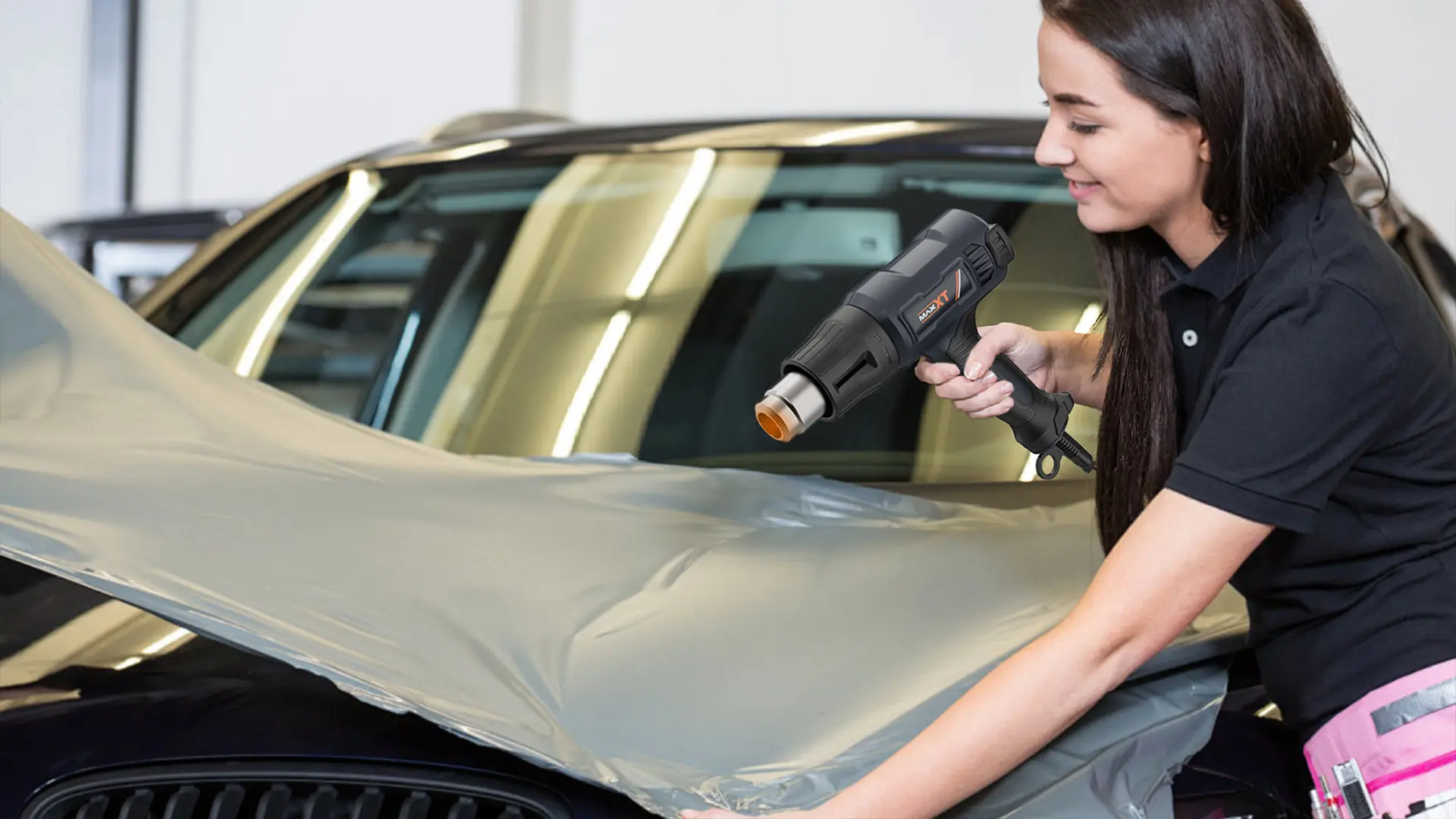
Beyond wrapping, heat guns serve four auto body applications — paint removal, decal stripping, plastic welding, and shrink tubing — each requiring different temperature ranges, airflow, and nozzles. Matching the right model to each use case prevents returns.
What this means for you: When a customer says “I need a heat gun for auto body work,” ask: “What kind of work?” Paint removal, decal stripping, and welding need different specs. This one question steers them to the right model on the first purchase.
| Application | Gun Temp Required | Airflow | Nozzle | Best MaxXT Model |
|---|---|---|---|---|
| Paint removal | 600-1000°F (315-538°C) | High | Flat / scraper | MHG1800 high (580°C) or MHG2000 variable |
| Decal / sticker removal | 300-500°F (150-260°C) | Medium | Flat | MHG1800 low (400°C) |
| Plastic welding | 250-400°F (120-200°C) | Low | Reflector / welding | MHG2000 variable (50-600°C) |
| Shrink tubing | 250-350°F (120-177°C) | Low | Concentrator | MDHG20V (280/530°C) or MHG1800 low |
MaxXT MHG2000 Variable Temperature Heat Gun
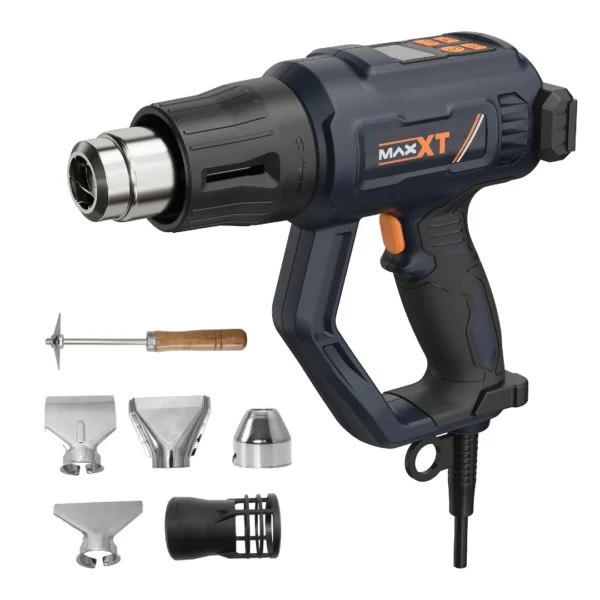
Professional 2000W heat gun with 50-600°C adjustable temperature control and four interchangeable nozzles — the versatile choice for mixed-use shops handling wrap, paint removal, and welding.
View product page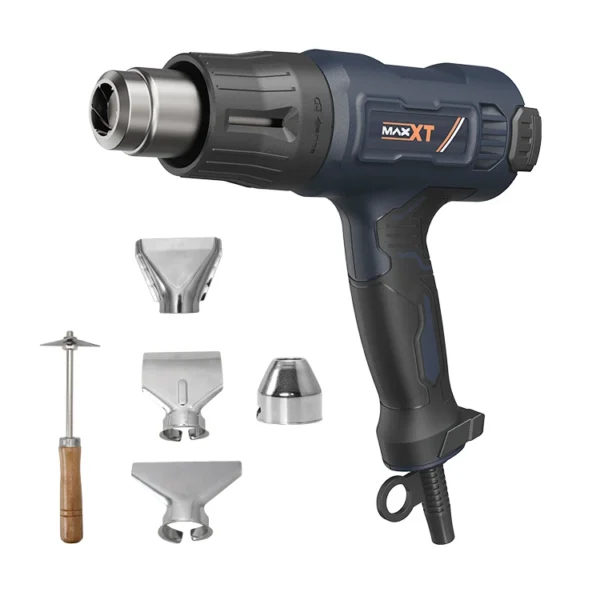
MaxXT MHG1800 Dual-Mode Heat Gun
Professional 1800W heat gun with dual-mode 400/580°C control and integrated stand — the affordable choice for dedicated paint removal and decal stripping stations.
View product page
MaxXT MDHG20V Cordless Heat Gun
Professional 20V cordless heat gun with dual-mode 280/530°C output — designed for mobile installers, fleet wraps, and tight spaces where corded tools cannot reach.
View product pageWhat Should Distributors Look for When Stocking Heat Guns?
In a market growing at 21.1% CAGR (Straits Research, 2026), stocking the right heat gun mix — variable vs. dual-mode, corded vs. cordless, certified vs. uncertified — captures up-sell and minimizes returns.
What this means for you: The difference between a cheap gun returned twice and a certified gun kept for years is the certification mark and warranty. Your customers rely on you to filter for them.
| Model | Type | Power | Temp Range | Best For | Why Stock It |
|---|---|---|---|---|---|
| MHG1800 | Corded, dual-mode | 1800W | 400/580°C | Dedicated paint/decal stations | Most affordable, simple, lowest return rate |
| MHG2000 | Corded, variable | 2000W | 50-600°C adjustable | Mixed-use shops | Largest addressable market; upsell opportunity |
| MDHG20V | Cordless, dual-mode | 20V battery | 280/530°C | Mobile installers, fleet wraps | Premium margin; growing mobile segment |
Certifications to Check — and Why They Matter for Liability
| Certification | What It Means | Why Distributors Should Care |
|---|---|---|
| CE | Conformite Europeenne safety standard | Required for EU market access |
| UL | Underwriters Laboratories listing | De facto requirement for US retailers; increasingly mandatory |
| EMC | Electromagnetic compatibility | Prevents interference with shop electronics |
| ISO 9001 | Quality management system | Signals consistent manufacturing (MaxXT holds this) |
| BSCI | Social compliance audit | Increasingly required by European retailers |
Recommended stocking strategy: 60% MHG2000 (broadest demand), 25% MHG1800 (budget/value option), 15% MDHG20V (premium niche). Adjust based on your customer mix — more mobile installers means more cordless allocation.
Why Is Heat Gun Safety Critical for Your Customers?
Heat guns reach up to 1200°F (649°C) with no visible flame, creating a serious burn and ignition hazard. Documented incidents at Princeton University include lab fires near flammable solvents with property damage over $32,000 (Princeton University EHS). Key safety practices:
- Use overheat protection: MaxXT heat guns include auto shutoff when internal temperature exceeds safe limits
- Never block air intake vents: Blocked vents trigger thermal shutdown — the #1 cause of “the gun stopped working” calls
- Use the built-in stand: Both MHG1800 and MHG2000 feature a lock-on switch and integrated stand for hands-free operation
- Keep away from flammable materials: Solvents, alcohol, and cleaning agents ignite at temperatures well below 1200°F
- Cool down before storage: Always run the gun on low for 30 seconds before switching off, then allow to cool completely
Recommended PPE: heat-resistant gloves and safety glasses. A simple reminder to “set it down on the stand, not on the bench” prevents the most common shop accident.
Frequently Asked Questions
What temperature should a heat gun be for vinyl wrap?
For installation, maintain 90-140°F (32-60°C) surface temp during stretching, then 185-212°F (85-100°C) for post-heat activation. Use an infrared thermometer to verify surface temperature.
Can a heat gun be used for auto body work?
Yes. Heat guns handle paint removal (600-1000°F), decal stripping (300-500°F), plastic welding (250-400°F), and shrink tubing (250-350°F). Recommend a variable-temperature model like the MaxXT MHG2000 (50-600°C adjustable) for mixed-use shops, or dual-mode MHG1800 for dedicated stations.
What are the MOQ and certification requirements for wholesale heat guns?
MaxXT offers 0 MOQ for initial orders with CE-certified products as standard. EMC, UL listing, and ISO 9001 certifications are available upon request. Free samples available for evaluation.
Variable-temperature vs. dual-mode heat gun — which sells better?
Variable-temperature guns (MHG2000, 50-600°C) address the broadest market. Dual-mode guns (MHG1800, 400/580°C) serve budget-conscious buyers. Recommended stocking ratio: 60% variable, 25% dual-mode, 15% cordless.
When a customer claims a wrap failed due to tool quality, how do I diagnose it?
Ask three questions: (1) “Did you post-heat the edges?” (2) “Was the surface cleaned with alcohol?” (3) “Did the gun shut off during use?” (Thermal protection trigger from blocked intake, not defect.) This turns a return request into coaching.
Do you need a heat gun for vinyl wrap?
Yes. Hair dryers cannot sustain the consistent 300-600°C output needed for professional wrap installation. A proper automotive heat gun is required.
How far should the heat gun be from vinyl wrap?
During stretching, 10-12 inches (25-30 cm). During post-heating, 5-7 inches (12-18 cm). Keep the gun moving in a steady sweep — never stationary.
Ready to Stock Professional Heat Guns for Your Customers?
Evaluate MaxXT’s quality firsthand. Request a free sample of our automotive heat gun lineup and compare against your current supplier. The margin difference speaks for itself.
Request Free SampleThe Bottom Line for Distributors
The global automotive wrap films market is not a niche — it is a $14.84 billion industry growing at 21.1% CAGR (Straits Research, 2026), and every wrap installed requires a heat gun. For distributors, the opportunity is not just in selling tools, but in becoming the technical resource that your customers rely on to diagnose problems, reduce returns, and make informed purchasing decisions.
The key differentiator between a distributor who competes on price and one who competes on value is technical knowledge. The distributor who can answer “Is it the tool or the technique?” over the phone will retain customers longer, face less price pressure, and capture more of the growing heat gun market.
References
- Straits Research. “Automotive Wrap Films Market Size, Share & Trends Analysis 2026-2034.” StraitsResearch.com, 2026. Source
- Princeton University Environmental Health & Safety. “Heat Gun Advisory.” EHS.Princeton.edu, 2025. Source
- 3M. “3M Wrap Film Series 2080 Product Bulletin.” 3M Commercial Solutions, February 2023. Post-heat recommendation: minimum 200°F (93°C), do not exceed 225°F (107°C). Application temperature range: 60-90°F (16-32°C). Source
- Avery Dennison. “Technical Bulletin #3.12: Application Instructions for Avery Dennison Supreme Wrapping Film.” Graphics.AveryDennison.com, 2023. Post-heat recommendation: 90-95°C (194-203°F). Source

 English
  Arabic
  French
  German
  Portuguese
  Russian
  Spanish
  Turkish