

Points clés à retenir
- Une visseuse à plaques de plâtre avec réglage de profondeur et une ponceuse électrique sont les deux outils électriques les plus importants ; il faut les acheter en priorité.
- Allouez 40 à 50% de votre budget d'outillage électrique aux outils d'installation de base (visseuse électrique, perceuse) et 25 à 35% aux outils de finition (ponceuse électrique).
- Achetez vos outils par étapes : d’abord les outils suspendus, puis les améliorations de finition, ensuite les systèmes de mélange/d’aspiration des poussières, et enfin les systèmes d’alimentation automatique pour le tri.
- L'aspiration des poussières n'est pas une option : le ponçage des cloisons sèches produit des particules ultrafines qui nécessitent une collecte de qualité HEPA.
- Les outils sans fil améliorent la portabilité sur les chantiers ; les outils filaires offrent une puissance constante pour les travaux à volume élevé — choisissez le format qui correspond le mieux à votre flux de travail.
Ce guide s'adresse aux entrepreneurs qui étoffent leur outillage pour cloisons sèches en raison de l'augmentation du nombre de chantiers, ainsi qu'aux bricoleurs expérimentés qui possèdent déjà des outils de base et souhaitent passer à l'outillage électroportatif pour des résultats plus rapides et plus professionnels. Il explique quoi acheter, dans quel ordre et comment établir un budget.
Comment prévoir mon budget pour l'achat d'outils électriques pour cloisons sèches ?
Allouez 40 à 50% de votre outil électrique pour cloisons sèches Consacrez votre budget à l'outillage de base pour la pose (visseuse électrique, perceuse), 25 à 35% à la finition (ponceuse) et le reste au mélange et à la gestion des poussières. Lors de l'achat d'outils électriques, privilégiez ceux qui vous feront gagner du temps. Par exemple, une visseuse électrique pour plaques de plâtre accélère considérablement la pose, les ponceuses électriques réduisent le temps de finition et un mélangeur électrique permet d'obtenir un enduit lisse en un rien de temps.
Allocation du budget pour les outils électriques
| Catégorie | % du budget | Outils |
| Outils d'installation de base | 40% – 50% | visseuse à plaques de plâtre, perceuse |
| Préparation et finition des surfaces | 25% – 35% | ponceuse à plaques de plâtre |
| Mélange | 10% – 15% | Perceuse à mélange |
| Systèmes de contrôle de la poussière | 10% – 20% | Extracteur de poussière, accessoires pour aspirateur |
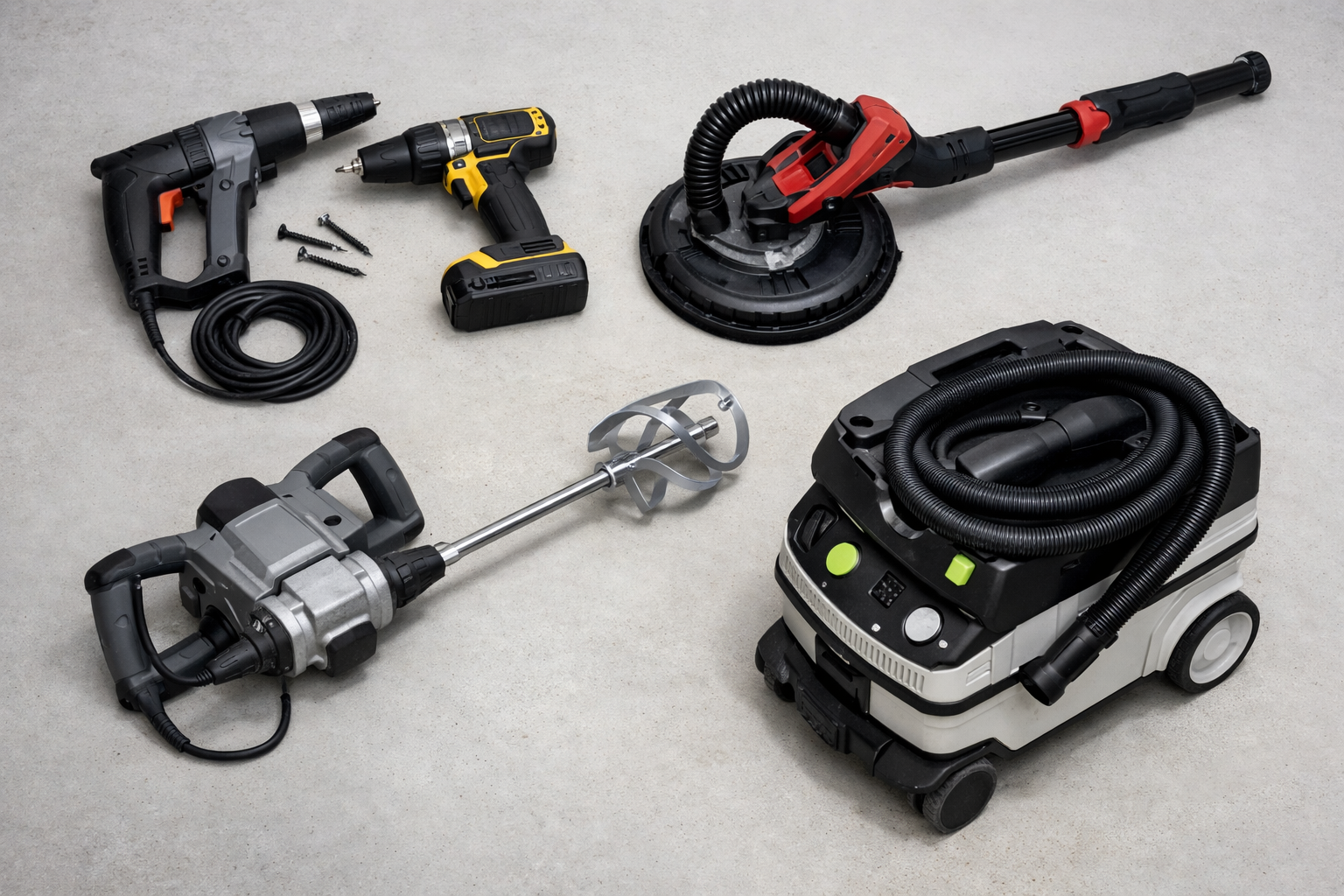
Quels outils électriques pour cloisons sèches devriez-vous privilégier en premier ?
Privilégiez les outils électriques pour plaques de plâtre qui accélèrent la pose, car il s'agit de la première étape. Les visseuses à plaques de plâtre et les ponceuses électriques, par exemple, permettent généralement un gain de temps immédiat considérable. Investissez dans des outils plus performants, comme les systèmes d'avance automatique, lorsque votre charge de travail le justifie.
Un autre facteur à prendre en compte est la fréquence d'utilisation. Privilégiez les outils en fonction de leur fréquence d'utilisation et du temps qu'ils permettent de gagner sur les tâches essentielles comme la fixation et la finition.
Note: Les entrepreneurs utilisent également des outils mécaniques, comme les chanfreineuses automatiques, en complément des outils électriques, pour accélérer les finitions. Bien qu'ils réduisent la main-d'œuvre, ce sont des outils mécaniques et non de véritables outils électriques.
Stratégie de commande
| Scène | Outils | But |
| Étape 1 : Installation | visseuse à plaques de plâtre | Accélérez la pose de plaques de plâtre |
| Étape 2 : Finalisation de la mise à niveau | ponceuse à plaques de plâtre électrique | Améliorer la vitesse de ponçage et la qualité de la finition |
| Étape 3 : Mise à niveau de la cohérence | Mélangeur électrique à palettes, système d'aspiration des poussières | Améliorer l'efficacité des flux de travail et protéger la santé |
| Étape 4 : Mise à l'échelle de la productivité | Visseuse à alimentation automatique | Augmenter la production sur les grands projets |
Outils électriques indispensables pour les cloisons sèches : un aperçu par catégorie
Voici une liste d'outils électriques pour plaques de plâtre recommandés par des experts, comprenant des visseuses à plaques de plâtre, une gamme d'outils de coupe et des outils de ponçage. L'utilisation d'outils électriques adaptés vous permettra de travailler plus rapidement, avec une meilleure précision, et d'obtenir une finition professionnelle avant de peindre.
Outils de mélange
Un mélangeur électrique à palettes est le seul outil électrique nécessaire à l'étape du mélange : il élimine les grumeaux et permet d'obtenir une texture de boue homogène beaucoup plus rapidement qu'un mélange manuel.
Mélangeur à palettes électrique
Ces outils, disponibles seuls ou fixés à une perceuse, accélèrent le mélange et éliminent les grumeaux, pour une boue à la consistance homogène. Privilégiez un mélangeur à lames en plastique faciles à nettoyer.
Outils de coupe
Trois outils de coupe électriques permettent de couvrir pratiquement tous les scénarios de découpe de plaques de plâtre : un outil de découpe rotatif pour les ouvertures de prises électriques, un outil multifonction oscillant pour les découpes de précision et une scie alternative pour la démolition.
Outil de découpe rotatif pour plaques de plâtre
UN outil électrique de découpe Doté de mèches à rotation rapide (25 000 à 30 000 tr/min), cet outil permet de découper rapidement les ouvertures pour les prises électriques, les bouches d'aération et les boîtes électriques. Ses guides de profondeur intégrés empêchent une découpe trop profonde, garantissant des ouvertures nettes sans endommager les cloisons sèches environnantes : un gain considérable en rapidité et en précision par rapport à un cutter.
outil multifonction oscillant
Cet outil électroportatif pour plaques de plâtre est un atout précieux pour votre atelier ; il est extrêmement polyvalent, capable de réaliser des découpes et des sciages précis, ainsi que des travaux de ponçage. Grâce à sa gamme de lames et de vitesses, il vous permet d'ajuster les plaques de plâtre autour des éléments fixes, d'installer des boîtes électriques ou des conduits de ventilation, et de lisser les bords en un clin d'œil. Si vous souhaitez gagner un temps précieux et éviter de passer des heures à réaliser des ajustements précis, cet outil est fait pour vous.
Scie alternative avec lame de coupe pour plaques de plâtre
Si vous avez des travaux de rénovation qui nécessitent la démolition de plaques de plâtre existantes, vous aurez besoin d'une scie sauteuse pour plaques de plâtre. Cet outil électrique permet non seulement de découper les plaques de plâtre en quelques secondes, mais aussi de sectionner les fixations utilisées pour les maintenir.
La lame, souvent dotée de dents à pointes en carbure, se déplace rapidement de haut en bas ou d'avant en arrière, effectuant des coupes grossières qui détruisent rapidement les plaques de plâtre, vous faisant gagner du temps à cette étape du travail.
Outils de fixation
La visseuse à plaques de plâtre est l'outil électrique le plus efficace pour accélérer la pose : elle peut doubler votre vitesse de fixation par rapport à une perceuse-visseuse standard.
visseuse à plaques de plâtre
Peu d'outils ont un impact aussi important au quotidien sur la pose de plaques de plâtre qu'une visseuse électrique. Chaque plaque nécessitant des dizaines de fixations, un outil rapide et précis est essentiel. Une visseuse professionnelle peut considérablement accélérer la pose, voire la doubler.
Choisissez une visseuse à plaques de plâtre dotée d'un système de réglage de profondeur ; vous pourrez ainsi contrôler la profondeur de pénétration des vis et éviter d'endommager le plaques de plâtre, ce qui pourrait ralentir votre travail.
Les visseuses électriques ne sont pas faciles à utiliser, du moins au début. Réfléchissez donc bien avant d'en acheter une et assurez-vous d'être prêt à consacrer du temps à vous familiariser avec l'outil.
Perceuse-visseuse (outil de support)
Vous en possédez probablement déjà une, car c'est un outil polyvalent pour percer, visser et mélanger. En pratique, les professionnels utilisent des modèles à couple élevé avec moteurs sans balais, mais les particuliers se contentent souvent d'une perceuse-visseuse pour les petits travaux de plâtrerie.
Bien qu'une visseuse électrique dédiée vous permette de travailler plus rapidement, une perceuse-visseuse est un excellent outil polyvalent pour les projets de cloisons sèches de petite et moyenne envergure.
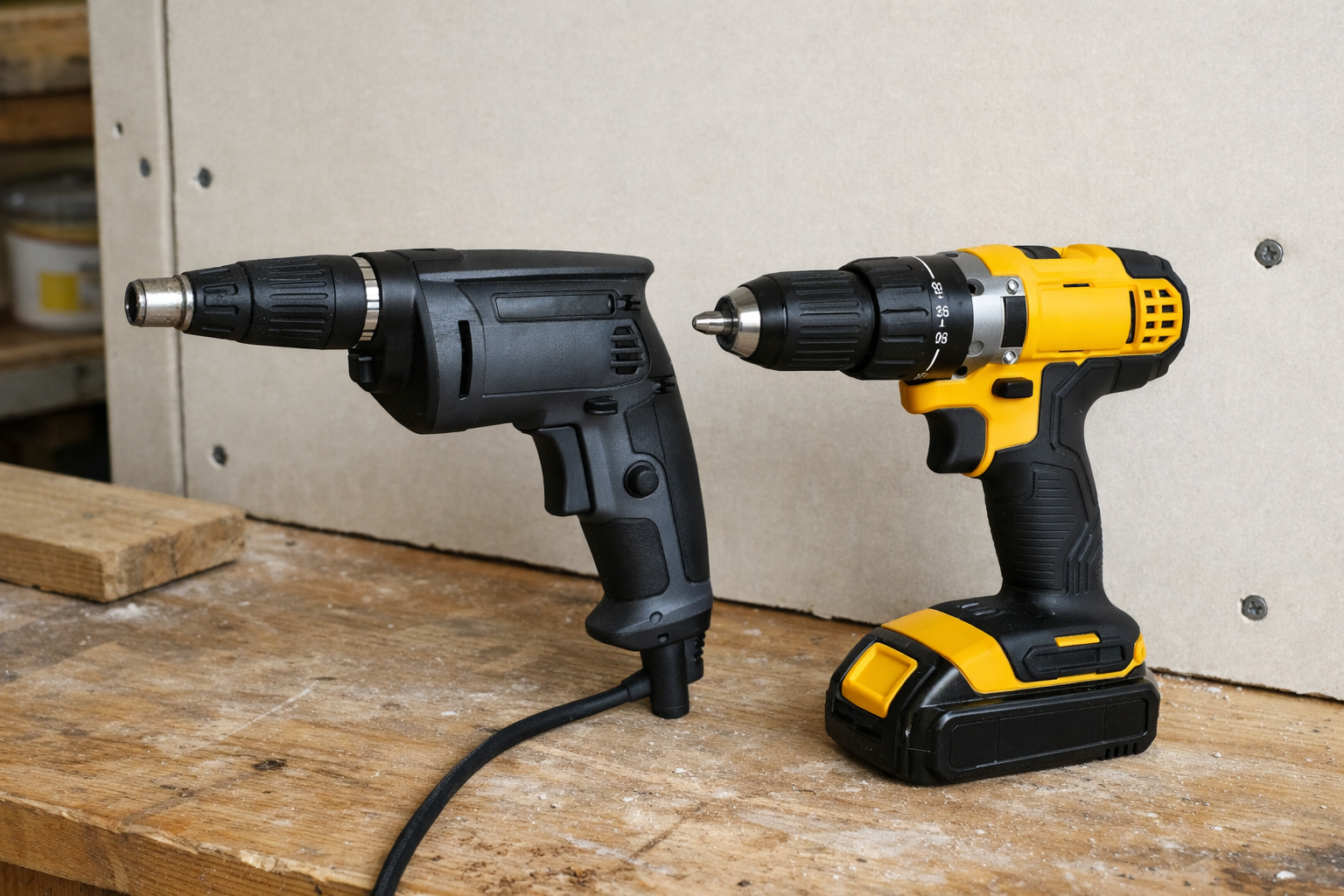
| Dimension | Pistolet à vis pour cloisons sèches | Perceuse-visseuse |
| Utilisation principale | Fixation dédiée pour plaques de plâtre | Perçage, fixation, mélange général |
| Contrôle de profondeur | Butée de profondeur réglable intégrée | Commande manuelle (sans butée de profondeur) |
| Vitesse pour les plaques de plâtre | Deux fois plus rapide sur les tâches à volume élevé | Convient aux petits travaux |
| courbe d'apprentissage | Modéré — nécessite de la pratique | Faible — la plupart des utilisateurs en possèdent déjà un. |
| Idéal pour | Entrepreneurs, gros travaux commerciaux | Bricoleurs, projets de petite et moyenne envergure |
| Gamme de prix typique | $80–$200+ | $50–$150 |
Outils de finition
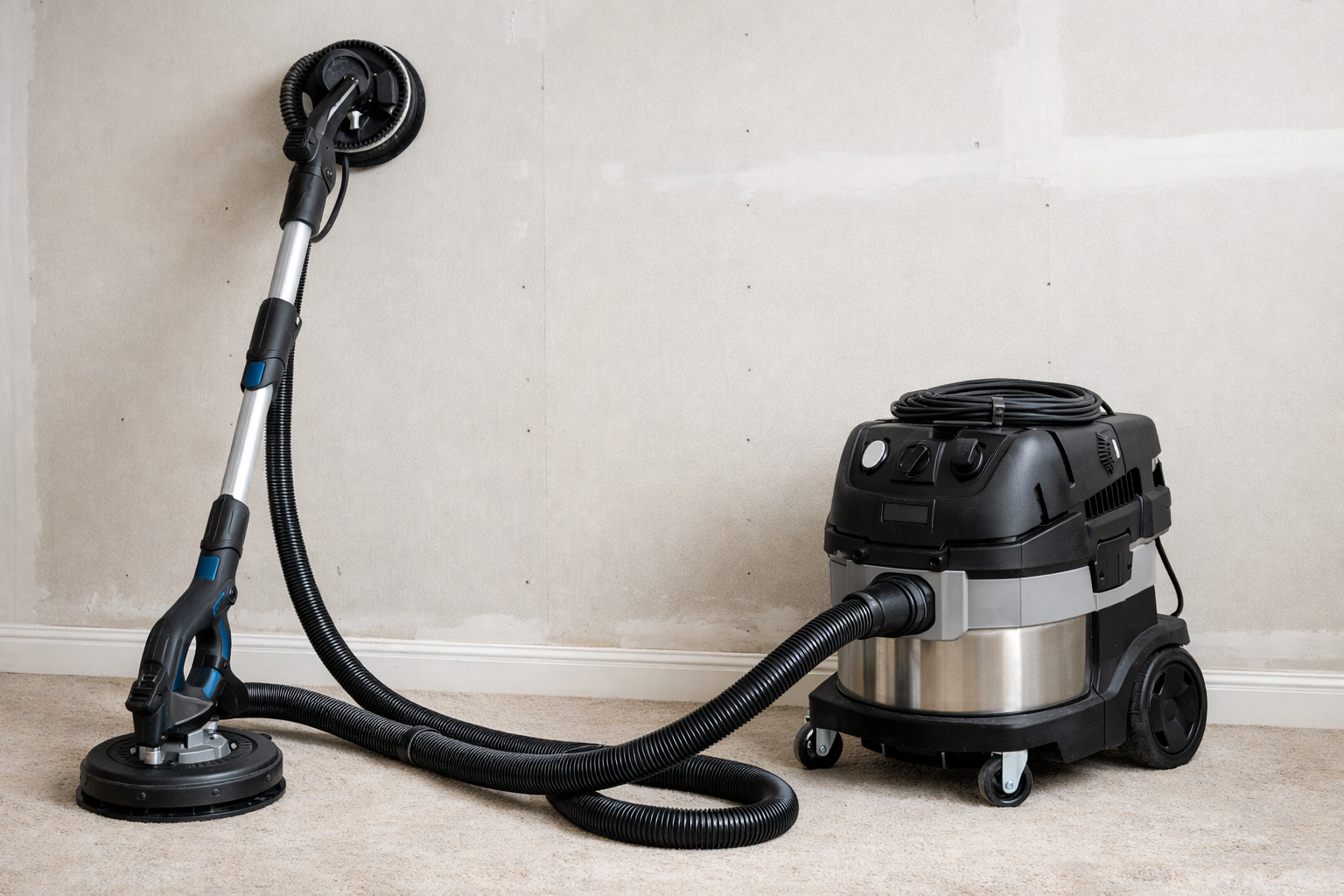
Une ponceuse électrique pour plaques de plâtre et un système d'aspiration des poussières transforment ensemble l'étape la plus lente et la plus salissante des travaux de pose de plaques de plâtre en un processus rapide et propre.
Ponceuse à plaques de plâtre (électrique ou sur perche)
Si vous avez déjà poncé des plaques de plâtre avec du papier de verre, vous savez à quel point c'est long, salissant et fatigant. Une ponceuse électrique résout tous ces problèmes. Son prix d'achat est élevé, mais elle est indispensable aux plaquistes qui travaillent sur de gros volumes de chantiers, car elle accélère considérablement le travail.
Principales raisons d'investir dans des outils de ponçage pour cloisons sèches
- productivité accrue – Les ponceuses électriques sont rapides et permettent de poncer de grandes surfaces en un temps record, bien plus vite qu'avec un ponçage manuel.
- Finitions impeccables – les motifs orbitaux répétitifs rapides ou orbitaux aléatoires produisent une finition lisse et professionnelle en préparation de la peinture.
- Investissement rentable – Au fil du temps, une ponceuse électrique pour cloisons sèches s'amortit grâce à une efficacité accrue, des coûts de main-d'œuvre réduits et une qualité de finition fiable.
- Contrôle amélioré de la poussière – Les ponceuses électriques avec système de dépoussiérage intégré minimisent la poussière et l'inhalation de poussières nocives.
systèmes d'extraction de poussière
Les outils électriques pour plaques de plâtre, en particulier les ponceuses électriques, génèrent beaucoup de poussières fines dangereuses. Heureusement, de nombreuses ponceuses sont équipées de systèmes d'aspiration des poussières avec filtres remplaçables, ce qui atténue ce risque pour la santé.
Dans le secteur de la construction, où les volumes de poussière sont importants, les systèmes de dépoussiérage sont des outils essentiels pour les plaquistes. Nombre d'entre eux utilisent un aspirateur commercial pour la collecte de poussière de plâtre, avec un filtre HEPA et des sacs spéciaux qui capturent la poussière de ponçage de plâtre ultrafine à la source.
Comment utiliser les outils électriques pour cloisons sèches en toute sécurité
L'utilisation sûre et efficace des outils électriques pour plaques de plâtre repose sur trois principes : choisir l'outil adapté à la tâche, privilégier la maîtrise de la vitesse et gérer la poussière à la source. Un usage approprié des outils électriques est indispensable pour garantir des performances optimales.
Privilégiez le contrôle et la cohérence à la vitesse.
Les outils comme les visseuses et les ponceuses sont conçus pour améliorer l'efficacité, mais s'ils ne sont pas utilisés avec précaution, vous risquez d'endommager les cloisons sèches, de trop serrer les vis et d'obtenir une finition irrégulière, autant de problèmes qui nécessitent des retouches, soit exactement le contraire de ce que vous souhaitez obtenir avec des outils électriques !
Choisir l'outil adapté à la tâche et utiliser les outils correctement
Utiliser le mauvais outil, ou mal utiliser le bon outil, peut non seulement provoquer des accidents, mais aussi endommager les plaques de plâtre, ce qui nuit à l'efficacité. Pour garantir la productivité :
- Utilisez des visseuses électriques pour les cloisons sèches plutôt que des perceuses classiques.
- Choisissez le grain du papier de verre et la vitesse de ponçage adaptés à la tâche.
- N’utilisez pas les outils pour des tâches pour lesquelles ils ne sont pas conçus.
Ne négligez pas l'ergonomie
Les outils légers facilitent la prise en main lors d'utilisations prolongées, mais l'ergonomie est tout aussi cruciale. Une conception ergonomique garantit une bonne prise en main et un positionnement optimal, permettant ainsi de travailler plus longtemps sans fatigue. Prévenir la fatigue est important car elle peut entraîner des erreurs.
FAQ
Quelle est la différence entre une visseuse électrique et une perceuse-visseuse ?
Une perceuse-visseuse est un outil polyvalent permettant de percer des trous et de visser. Avec l'accessoire adéquat, elle peut également servir de ponceuse ou de mélangeur. Une visseuse à plaques de plâtre est spécialement conçue pour la pose de plaques de plâtre.
Une perceuse peut-elle remplacer une visseuse à plaques de plâtre ?
Oui et non. Une perceuse-visseuse sans fil peut remplacer une visseuse électrique pour les réparations domestiques courantes et les petits travaux de plaques de plâtre, mais pas pour les grands projets de plaques de plâtre nécessitant un vissage en grande quantité et à profondeur constante.
Quelle taille de visseuse me faut-il pour les plaques de plâtre ?
Pour les plaques de plâtre standard de 12,7 mm et 15,9 mm, une visseuse électrique utilisant des vis à filetage fin #6 (31,8 mm pour une seule couche, 41,3 mm pour une double couche) est recommandée. Choisissez un modèle avec réglage de profondeur pour enfoncer les vis juste sous la surface du papier sans le percer.
Ai-je besoin d'une ponceuse spéciale pour les plaques de plâtre ?
Une ponceuse à plaques de plâtre dédiée — soit une ponceuse à perche avec tête motorisée, soit une ponceuse portative ponceuse orbitale Avec système d'aspiration des poussières, cette ponceuse surpasse les ponceuses classiques car elle est conçue pour les grandes surfaces planes et les poussières fines spécifiques à la finition des plaques de plâtre. Les ponceuses orbitales classiques conviennent aux petites réparations, mais elles manquent de portée et d'efficacité pour les projets de rénovation de pièces entières.
Conclusion
Choisir les bons outils pour plaques de plâtre ne consiste pas tant à posséder tous les outils qu'à privilégier ceux qui optimisent la rapidité, la régularité et la qualité globale du travail. Une liste d'outils pour plaques de plâtre doit privilégier les outils essentiels à la pose et à la finition.
En définitive, les outils électriques les plus indispensables pour les plaquistes sont ceux qui réduisent le temps de travail et améliorent la régularité des résultats, favorisant ainsi une croissance durable. De plus, investir dans un aspirateur de poussières est crucial pour garantir un environnement de travail propre et sécuritaire.
MaxXT Nous fabriquons et vendons notre propre marque d'outils électroportatifs pour cloisons sèches, incluant une gamme de ponceuses, visseuses, aspirateurs de poussière, mélangeur électrique à palette, bref, tous les outils nécessaires pour optimiser votre productivité. Nous vendons aux particuliers et proposons des offres de partenariat avantageuses aux revendeurs et distributeurs. Contactez-nous dès aujourd'hui pour plus d'informations.
 French
  English
  Arabic
  German
  Portuguese
  Russian
  Spanish
  Turkish