
Principais conclusões
The global joint compound market was valued at $5.72 billion in 2025, projected to reach $9.97 billion by 2034 at 6.38% CAGR (Fortune Business Insights, 2026). North America’s dry mix mortar market is forecast at 99.08 million tons by 2031 at 4.45% CAGR (Mordor Intelligence, 2026).
Both materials are commonly mixed with the same category of tool — a handheld electric paddle mixer — but require different RPM ranges, paddle geometry, and technique. Using the wrong speed or paddle is a documented cause of air entrainment, variable set time, and workability problems (USG CGC Construction Handbook Ch. 12).
For distributors, the most common “defective mixer” return isn’t a hardware failure — it’s a wattage or speed mismatch between the tool sold and the material the customer is actually mixing.
This guide equips distributors with the product knowledge to recommend the right paddle mixer and speed setting for each customer segment, and to diagnose common mixing complaints before they become returns.
The global joint compound market reached $5.72 billion in 2025 and is projected to grow to $9.97 billion by 2034 at 6.38% CAGR (Fortune Business Insights, 2026). North America’s dry mix mortar market — covering plasters, tile adhesives, grouts, and concrete repair mortars — is on pace to reach 99.08 million tons by 2031 at 4.45% CAGR, with residential construction accounting for 48.74% of end-use share (Mordor Intelligence, 2026). Both material categories depend on the same tool family: the handheld electric paddle mixer.
The joint compound market ($5.72B in 2025) and the dry mix mortar market (76.27M tons in 2025, North America) both rely on electric paddle mixers for on-site preparation — but the correct technique differs sharply between them. Drywall compound requires moderate-speed, low-shear mixing with a spiral/helical paddle to avoid air entrainment, while mortar demands higher torque at controlled low-to-medium speed with a wider paddle. Distributors who understand this distinction can reduce returns tied to speed or paddle mismatch — MaxXT’s dealer network reports this as the leading cause of “defective mixer” complaints.
Many distributors sell paddle mixers as a single generic SKU without understanding that drywall compound and mortar require different RPM ranges and paddle types — a mismatch that shows up later as customer complaints about air bubbles, weak mix, or “the mixer struggled.” This guide covers paddle mixer fundamentals, the technique and speed differences between drywall compound and mortar, a model-selection matrix for different customer segments, and a diagnostic framework for common mixing complaints.
MaxXT’s wholesale electric paddle mixer lineup includes the entry-level MDM1050, the dual-speed MPM1600, and the cordless MDPM20V. This guide is a decision-making resource for distributors who need to understand paddle mixer technique well enough to advise customers, diagnose complaints, and stock the right inventory.
O que é um misturador elétrico de pás e por que o controle de velocidade é importante?
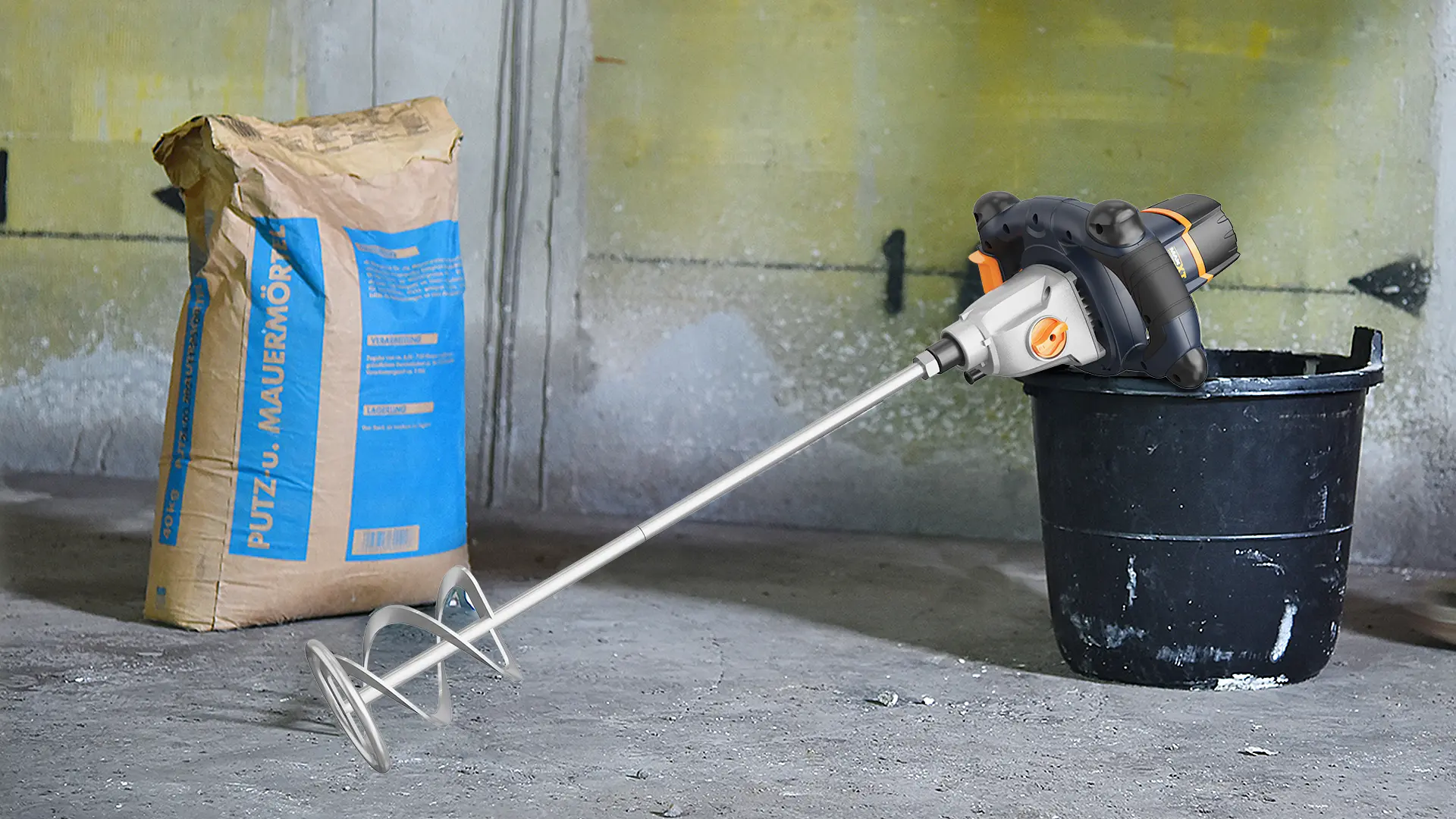
An electric paddle mixer is a handheld power tool that drives a helical or flat paddle attachment to blend dry and liquid construction materials — most commonly drywall joint compound, mortar, thinset, plaster, and paint. Unlike a standard drill, it is built for sustained torque at low RPM under heavy load, with spindle connections (typically M14) that secure mixing paddles rated for high-viscosity materials.
Why this matters for dealers: Speed range is the single spec that determines which materials a given model handles well. Get this wrong when advising a customer, and the tool underperforms even though nothing is broken. The USG CGC Construction Handbook documents that mixing action with “improper or insufficient shear” produces stiff, unworkable material — a direct result of wrong speed or paddle choice, not tool failure (USG CGC Construction Handbook Ch. 12).
Three motor configurations dominate the market:
- Single-speed (fixed RPM): Simplest design, lowest cost. Suits one material type well — typically drywall compound at moderate speed. Example: MaxXT MDM1050.
- Dual-speed: Two mechanical gear ratios (e.g., 180-460 and 300-750 RPM). The low range handles mortar and thinset; the high range handles compound and plaster. Example: MaxXT MPM1600 and MDPM20V.
- Variable-speed: Continuous RPM adjustment via trigger or dial. Most versatile but typically found on higher-wattage industrial units.
Additional features distributors should know: Soft-start prevents splash-out and motor strain at startup. Constant-speed electronics maintain RPM under load — critical for mortar where the paddle encounters varying resistance. Both the MPM1600 and MDPM20V include soft-start and constant-speed circuitry.
Mixing-related defects documented by USG fall into three documented categories: air entrainment from excessive speed or wrong paddle type, variable set time within a single batch caused by both insufficient and excessive mixing, and stiff, unworkable material resulting from improper or insufficient shear action. All three are technique-dependent and preventable with correct paddle choice and speed selection, reinforcing that the majority of “bad tool” complaints trace back to how the tool is used.
Massa corrida versus argamassa: por que a mesma ferramenta exige técnicas diferentes?
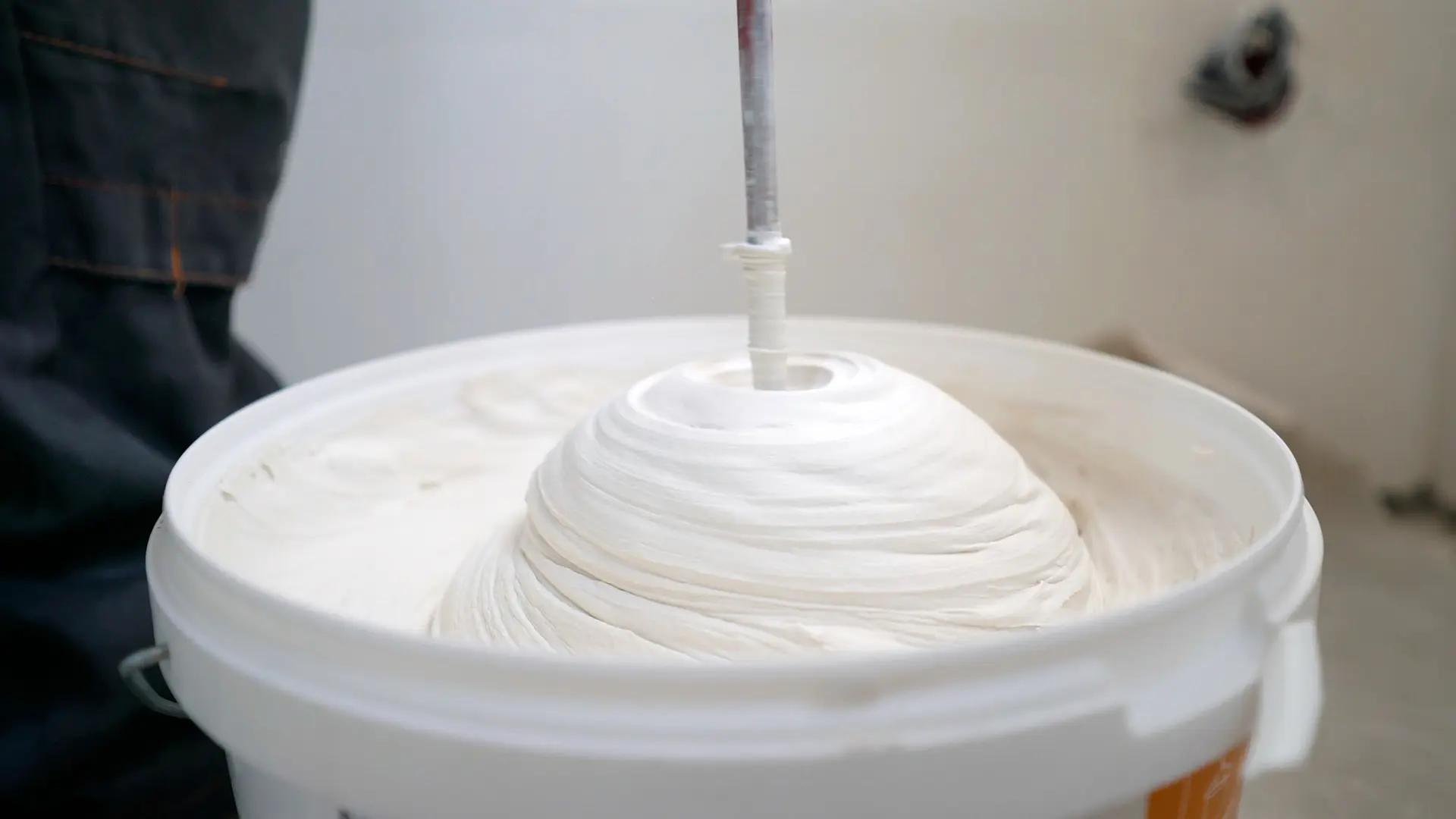
Drywall joint compound is a low-shear, air-sensitive material that mixes best at moderate speed with a spiral or helical paddle. Mortar and thinset are high-viscosity, abrasive materials that need higher torque and a wider mortar-mixing paddle at controlled low-to-medium speed. Using drywall technique on mortar stalls the motor; using mortar technique on compound whips in excess air.
What this means for you: When a customer buys a paddle mixer and uses it for both compound and mortar, the choice between a single-speed entry-level unit and a dual-speed model determines whether they need a second tool. This is your upsell opportunity — and the most common source of return if you sell the wrong tier.
| Parameter | Drywall Joint Compound | Mortar / Thinset |
|---|---|---|
| Recommended RPM | 400-600 RPM (moderate) | 150-400 RPM (low to medium) |
| Paddle Type | Spiral or helical | Wide-blade mortar paddle |
| Shear Requirement | Low to moderate | High — sustained torque needed |
| Air Sensitivity | High — overmixing entrains air | Low — air entrainment less common |
| Mixing Duration | Stop as soon as uniform | Mix to stiff, workable consistency; slake 5-10 min |
| Typical Batch Volume | 5-20 gallons (20-80L) | 20-32 gallons (80-120L) |
| Common Defect | Bubbles / blisters from air entrainment | Slump / weak mix from wrong water ratio |
| USG Documented Issue | High-speed or wrong paddle entrains air (Problem #1) | Insufficient shear → stiff, unworkable material |
USG documents that mixing with a high-speed paddle or the wrong paddle type entrains air into veneer plaster and joint compound, a leading cause of bubbles and blisters after application (USG CGC Construction Handbook Ch. 12, Problem #1). For mortar, the inverse problem occurs: insufficient shear action from low RPM or undersized paddle produces a stiff, unworkable mix that cannot hold shape — leading the contractor to add excess water, which then causes slump and weak cure.
Dealer insight per material:
- Drywall Joint Compound — Moderate speed (400-600 RPM), spiral/helical paddle, mix just until uniform and stop as soon as no dry pockets remain. Overmixing whips in air and causes bubbles after drying.
- Veneer Plaster — Similar low-air-tolerance profile to joint compound. USG flags “foaming action” from high-speed mixing as a top defect cause for this material.
- Mortar / Thinset — Lower speed (150-400 RPM) but higher torque requirement, wider paddle blade, mix to a stiff consistency. Insufficient shear leaves the mix stiff and unworkable; excessive water plus high speed causes slump.
- Type S / N Mortar (masonry) — Needs sustained torque at low RPM for full batch volumes (60-120L). This is where undersized wattage becomes the leading dealer complaint.
Como escolher a velocidade e a potência ideais do misturador de pás para cada tipo de material?
For dealers, wattage and speed range are the two specs that separate “handles drywall finishing” from “handles daily mortar batches.” A single-speed 1050W unit suits light, occasional drywall compound work; a dual-speed 1600W or 20V cordless unit with a 120L max volume rating serves higher-volume mortar and mixed-use customers.
Why dealers need this: When a customer says “the mixer bogs down,” the diagnostic question is whether they are running full-volume mortar batches through an entry-level, single-speed unit rated for lighter material. The MaxXT MDM1050 (1050W, single-speed, 80L max) is a capable drywall compound mixer. For mixed-use contractors handling both compound and mortar, the dual-speed MPM1600 (1600W, 120L max) covers both material types without switching tools. Mobile masons and tile setters who need cordless flexibility on jobsites are well served by the MDPM20V, a 20V dual-speed cordless unit with the same 120L capacity.
The global gypsum board market is projected to grow from $58.4 billion in 2025 to $91.2 billion by 2034 at 5.1% CAGR (Dataintelo, 2026). Rising drywall volume means more finishing compound mixed on jobsites — and more paddle mixer demand from that customer segment.
Key specs to compare across models:
- Motor power: 1050W (entry-level) vs. 1600W (mid-range) — higher wattage delivers sustained torque under heavy mortar loads
- Speed control: Single-speed vs. dual-speed — the latter is essential for shops handling both compound and mortar
- Max mixing volume: 80L vs. 120L — maps to customer segment (drywall finisher vs. mason/tile setter)
- Soft-start: Prevents splash-out and reduces motor strain — present on MPM1600 and MDPM20V
- Constant-speed electronics: Maintains RPM under load — critical for mortar where resistance varies mid-batch
- Spindle: M14 — industry-standard thread for paddle interchangeability across all three models
The global gypsum board market — the primary demand driver for drywall finishing compound and the paddle mixers that blend it — is projected to grow from $58.4 billion in 2025 to $91.2 billion by 2034 at 5.1% CAGR (Dataintelo, 2026). This rising volume directly translates to increased paddle mixer demand from the drywall finisher segment. Meanwhile, the North America dry mix mortar market adds 22.81 million tons of volume between 2025 and 2031 (Mordor Intelligence), driving parallel demand from masonry and tile customers. Distributors who stock a wattage/speed tier for each segment capture both growth curves.
Como misturar massa corrida para drywall corretamente — passo a passo?
The #1 complaint chain for drywall compound is “bubbles after it dries” — usually traced to mixing technique, not the compound or the tool. USG documents that both insufficient AND excessive mixing cause “variable set time within batch” — there is a real stopping point, not a “the longer the better” assumption (USG CGC Construction Handbook Ch. 12, Problem #2).
Why dealers need to know this: When a contractor calls saying “this compound is foaming” or “it went bad,” the answer is almost always about mixing technique, not batch quality. You can resolve the complaint in one phone call.
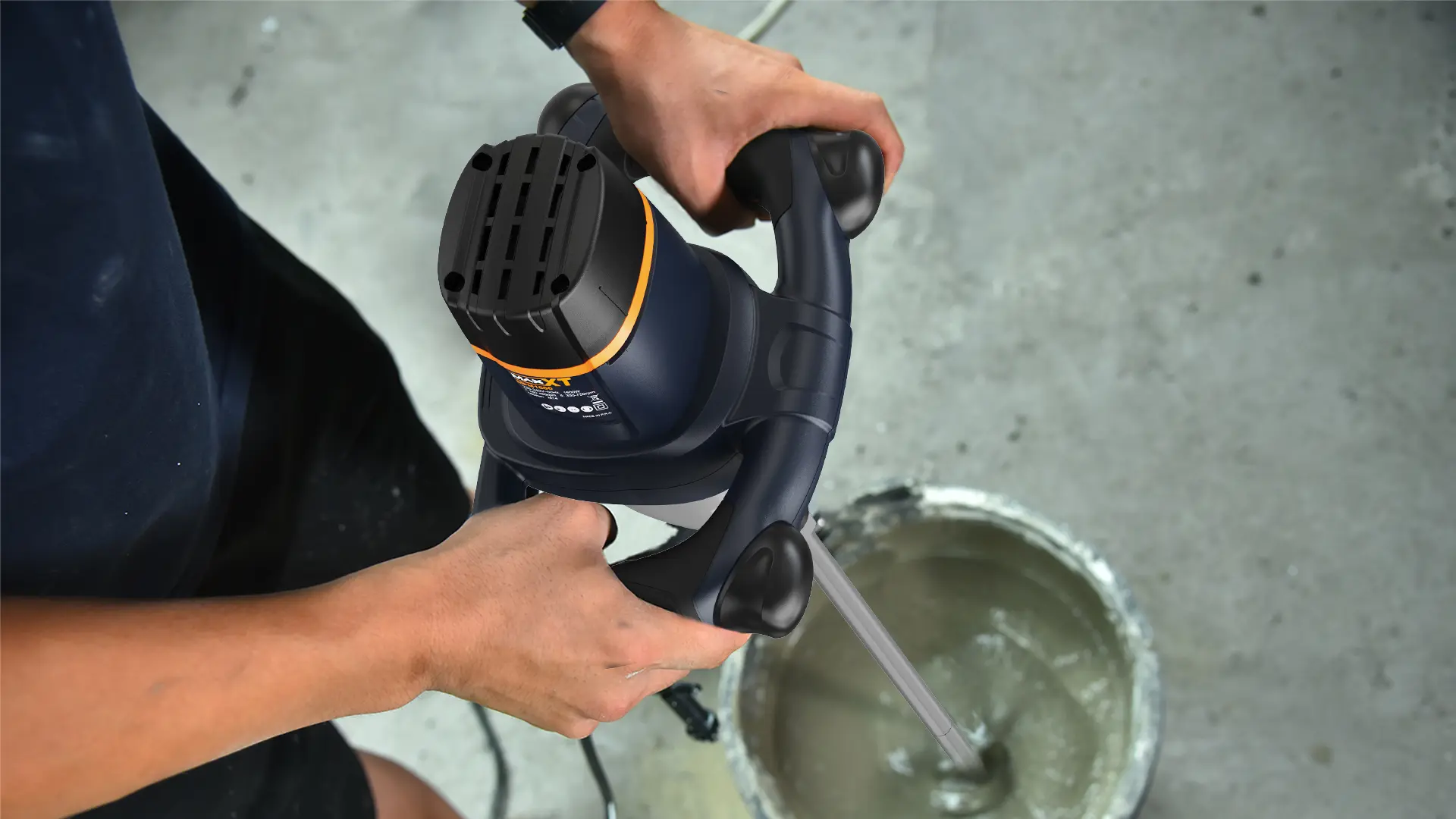
- Start the mixer at the lowest speed before the paddle touches material. This prevents splash-out and motor strain. On dual-speed models like the MPM1600, start in first gear (180-460 RPM).
- Lower the paddle fully into the bucket before increasing speed. Partial submersion whips air into the compound. The paddle should be covered by at least 6 inches of material.
- Mix at moderate speed in a steady up-and-down motion. Keep the paddle moving vertically through the bucket to ensure uniform blending. Stay in the 400-600 RPM range — well within the lower band of a dual-speed unit’s second gear.
- Stop as soon as consistency is uniform. Do not continue mixing “for good measure.” USG documents that excessive mixing contributes to foaming and variable set time (Problem #1 and #2). The correct stopping point is when no dry pockets remain and the compound is smooth — typically 2-3 minutes for a standard 5-gallon bucket.
- Scrape bucket sides and bottom by hand for any unmixed pockets. No paddle can reach into corners. A quick hand scrape before use prevents hard lumps from reaching the trowel.
Critical insight from MaxXT’s dealer network: The most common compound mixing mistake is “mixing faster to get it done quicker.” Higher RPM does not mean faster mixing — it means air entrainment. A dual-speed mixer like the MPM1600 running in first gear produces better compound consistency than a single-speed unit run at fixed moderate RPM, because soft-start and constant-speed electronics prevent the RPM surge that traps air.
Como misturar argamassa e cola de assentamento corretamente — passo a passo?
Masonry and tile customers will ask why their mortar “won’t hold a peak” or “slumps off the trowel” — usually a water ratio or mixing sequence issue, not a bad batch. For full 80-120L batches, a fixed-speed entry-level unit under 1200W will bog down under sustained mortar load — this is a wattage mismatch, not a defect, and the fix is stocking the right tier for that customer.
Why dealers need this: Mortar mixing complaints account for the highest share of “the mixer doesn’t work” calls in MaxXT’s dealer network. The root cause is almost always wattage mismatch or incorrect water ratio, not motor failure.
- Add most of the water to the bucket first, then add dry material gradually. Adding water to dry mix creates dust and makes consistent hydration harder to achieve. The correct sequence is: 80% of water → add dry mix while mixing → adjust with remaining water.
- Mix at low-to-moderate speed with a wide mortar paddle. Sustained torque matters more than high RPM. Use first gear (180-460 RPM) on a dual-speed unit. The wide paddle blade generates the shear needed to wet out cementitious materials without cavitation.
- Mix to a stiff-but-workable “peanut butter” consistency. The correct mortar consistency holds a peak when lifted with a trowel and does not slump off a vertical surface. If it slumps, the water ratio is too high — do not add more water to fix it.
- Let the mortar slake (rest) for 5-10 minutes per manufacturer spec, then briefly re-mix before use. Slaking allows the dry particles to fully absorb water. Re-mix for 30-60 seconds before application. Do not skip this step — it directly affects bond strength.
- Never add water to loosen mortar after slaking. Adding water after slaking breaks the water-cement ratio and reduces compressive strength. The correct response is to mix a fresh batch at the right water ratio from the start.
Dealer insight: For full 80-120L mortar batches, a fixed-speed entry-level unit under 1200W (like the MDM1050) will bog down under sustained load. This is a wattage mismatch — not a defect — and the fix is recommending the next tier (MPM1600 or MDPM20V) for that customer’s actual batch volume.
Qual batedeira de pás você recomendaria para cada segmento de clientes?
Your customers fall into three segments based on material and volume. Here is exactly what to recommend for each.
| Customer Type | Recommended Model | Por que | Upsell Opportunity |
|---|---|---|---|
| Drywall finisher (light/occasional compound mixing) | MDM1050 (1050W, single-speed, 80L) | Budget-friendly, sufficient torque for compound-only use | Spare paddle attachments, buckets |
| Mixed-use contractor (compound + occasional mortar) | MPM1600 (1600W, dual-speed, 120L) | Two speed ranges cover both material types without switching tools | Wider mortar paddle attachment |
| Mason/tile setter or mobile crew (daily mortar batches, cordless flexibility) | MDPM20V (20V cordless, dual-speed, 120L) | Sustained torque without a cord on jobsite, battery ecosystem upsell | Spare battery, charger, mortar paddle |
| Spec | MDM1050 | MPM1600 | MDPM20V |
|---|---|---|---|
| Poder | 1050W corded | 1600W corded | 20V cordless (brushless) |
| Velocidade | Single-speed | Dual (180-460 / 300-750 RPM) | Dual (0-450 / 0-720 RPM) |
| Max Volume | 80L (21 gal) | 120L (32 gal) | 120L (32 gal) |
| Fuso | M14 | M14 | M14 |
| Partida suave | — | Sim | Sim |
| Const. Speed | — | Sim | Sim |
| Peso | ~8.2 lbs | 9.3 lbs (4.25 kg) | 7.87 lbs (3.57 kg) |
| Ideal para | Compound-only | Uso misto | Mobile / cordless |
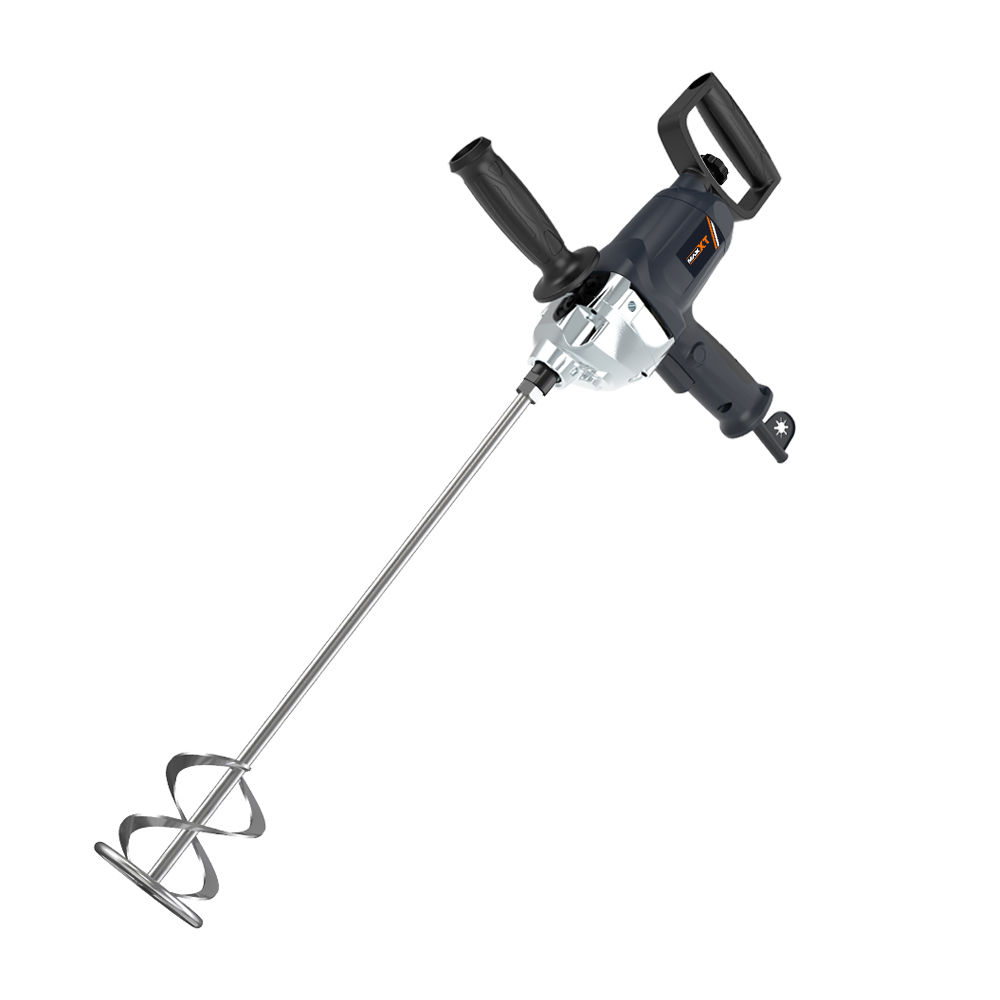
MaxXT MDM1050 Electric Paddle Mixer
Entry-level 1050W paddle mixer with single-speed operation and M14 spindle. Rated for up to 80L (21 gal) mixing volume. The budget-friendly choice for drywall finishers who mix compound exclusively.
View Product →
MaxXT MPM1600 Electric Paddle Mixer
Professional 1600W paddle mixer with dual-speed operation (180-460 / 300-750 RPM), soft-start, and constant-speed electronics. Rated for up to 120L (32 gal). Covers both drywall compound and mortar without switching tools.
View Product →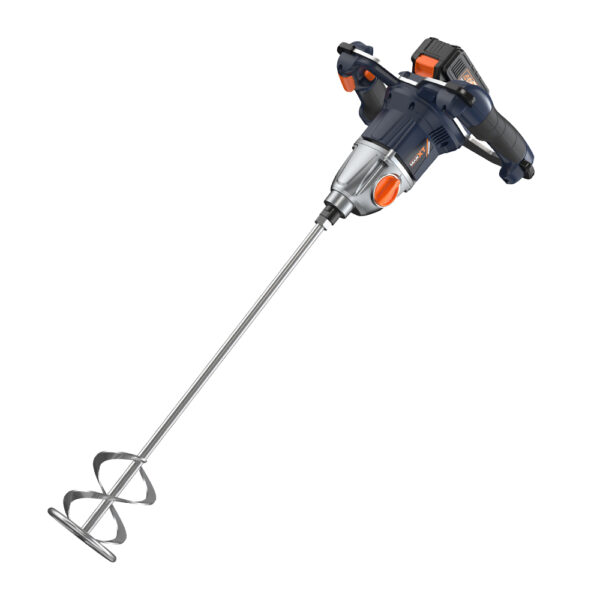
MaxXT MDPM20V Cordless Brushless Paddle Mixer
Professional 20V cordless paddle mixer with brushless motor and dual-speed operation (0-450 / 0-720 RPM). Soft-start, constant-speed electronics, and 120L (32 gal) max volume. Designed for mobile masons, tile setters, and jobsites without reliable power.
View Product →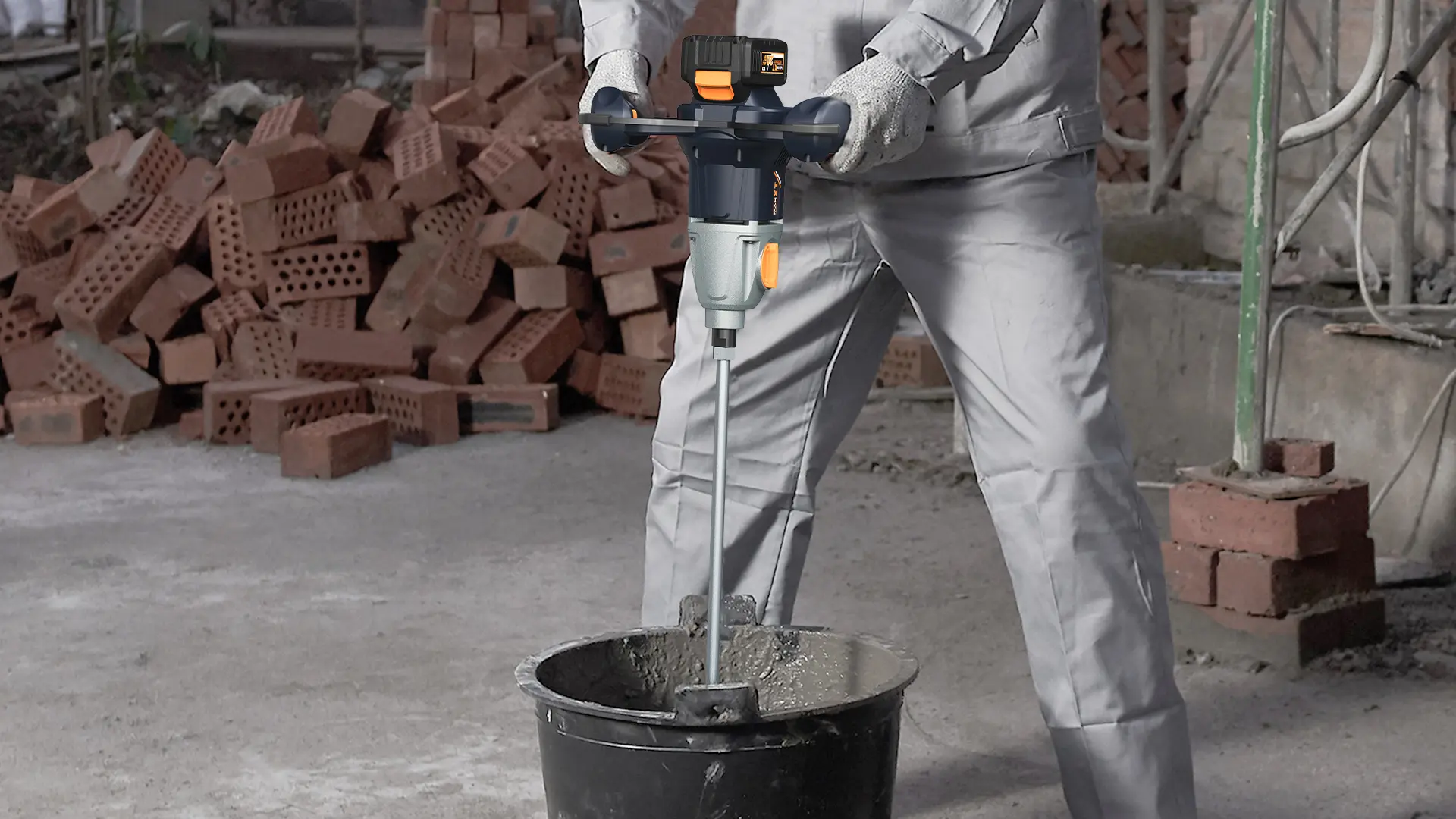
Diagnóstico de reclamações de clientes: problema com a ferramenta ou problema com a técnica?
Across MaxXT’s dealer network, wattage-and-volume mismatch — not motor failure — accounts for the largest share of “the mixer doesn’t work” complaints on mortar-heavy jobs. Below are the four most common complaints and how to resolve them over the phone.
| Customer Complaint | Root Cause | Diagnosis Question | Dealer Action |
|---|---|---|---|
| “Compound has bubbles after drying” | Overmixing or high-speed mixing — air entrainment (USG Problem #1) | “What speed setting were you using, and how long did you mix?” | Reduce speed, stop as soon as uniform. Coach on stopping point. |
| “Mortar won’t hold shape / slumps” | Excess water added, or insufficient mixing time | “Did you add all the water at once, and did you let it slake?” | Correct water ratio, mix to stiff-but-workable consistency, slake 5-10 min. |
| “Mixer bogs down mid-batch” | Wattage/torque mismatch for batch volume | “How many gallons are you mixing per batch?” | If >80L mortar, recommend next wattage tier (MPM1600 or MDPM20V). |
| “Mix has dry pockets after mixing” | Insufficient mixing time or paddle too small for bucket diameter | “Is the paddle fully submerged? How wide is your bucket?” | Confirm full paddle submersion, mix longer at correct speed. |
Dealer Diagnostic Flowchart: Is It the Tool or the Technique?
Customer says: “The paddle mixer doesn’t work right” / “It bogs down” / “The mix is bad”
Ask #1: “What material are you mixing — drywall compound or mortar?” → Directs you to the right troubleshooting path.
Ask #2: “How many gallons per batch?” → If mortar >80L and the tool is the MDM1050 or similar entry-level, this is a wattage mismatch.
Ask #3: “Did you mix until it looked smooth and then stop?” (compound) or “Did you let the mortar slake?” (mortar) → If no to either, technique issue.
Likely outcome: Technique or sizing mismatch in ~75% of cases. Provide coaching, recommend the right model tier, keep the sale.
Perguntas frequentes
Qual a velocidade ideal de um misturador de pás para massa corrida?
Moderate speed — typically in the lower half of a variable-speed unit’s range (roughly 400-600 RPM) — mixed with a spiral or helical paddle. Running compound at high speed whips in excess air, a documented cause of bubbles and blisters after drying (USG CGC Construction Handbook Ch. 12, Problem #1).
A mesma betoneira de pás pode ser usada tanto para argamassa quanto para massa de rejunte?
Yes, if the unit has variable or dual-speed settings and enough sustained torque, such as the MaxXT MPM1600 or MDPM20V. A fixed single-speed entry-level mixer like the MDM1050 is better suited to one material category (drywall compound) rather than both. Stocking a dual-speed tier alongside your entry-level unit lets you match the right tool to each customer segment instead of a one-size-fits-all SKU.
Qual a diferença entre uma pá misturadora de argamassa e uma pá para massa corrida?
Drywall and compound paddles are typically spiral or helical for smooth, low-shear blending that minimizes air entrainment. Mortar paddles are wider-bladed for higher-viscosity, more abrasive material and are designed to work at lower RPM with more sustained torque. The M14 spindle on all MaxXT models makes it easy to swap between paddle types without changing tools.
Por que minha massa para drywall apresenta bolhas de ar após a mistura?
Air entrainment from mixing at too high a speed or with the wrong paddle type is a documented root cause (USG CGC Construction Handbook Ch. 12, Problem #1). Reduce speed and stop mixing as soon as the compound reaches uniform consistency. Overmixing does not improve compound quality — it makes it worse.
Qual a quantidade de argamassa que uma betoneira manual consegue processar em uma única leva?
It depends on motor wattage and rated max mixing volume. Entry-level units like the MDM1050 are typically rated around 80L (21 gallons). Higher-wattage dual-speed units like the MPM1600 or MDPM20V are rated up to 120L (32 gallons) for full-volume masonry batches. Attempting a 120L mortar batch with an 80L-rated unit will bog the motor and trigger the most common “mixer doesn’t work” complaint — a wattage mismatch, not a defect.
Pronto para montar seu estoque com a linha ideal de misturadores de pás?
Evaluate MaxXT’s paddle mixer quality firsthand. Request a free sample and compare our MDM1050, MPM1600, and MDPM20V against your current supplier. The build quality, feature set, and margin speak for themselves.
Request Free SampleConclusão para os distribuidores
Paddle mixers are a shared-category tool across two growing material markets — joint compound ($5.72B in 2025, growing to $9.97B by 2034) and dry mix mortar (76.27 million tons in 2025, growing to 99.08 million tons by 2031). But correct speed and paddle selection differ between them. Distributors who understand this distinction reduce returns and become a technical resource for their customers.
The key differentiator between a distributor who competes on price and one who competes on value is product knowledge. The distributor who can answer “Which paddle mixer for which material?” over the phone will retain customers longer, face less price pressure, and capture more of the growing paddle mixer market. Stocking a dual-speed or cordless tier alongside your entry-level unit lets you match the right tool to each customer segment instead of a one-size-fits-all SKU — reducing returns tied to wattage mismatch and building a reputation as the dealer who knows the material.
For wholesale pricing, OEM/ODM options, and dealer support programs, Entre em contato com a MaxXT.
Referências
- Fortune Business Insights. “Joint Compound Market Size, Share & Industry Analysis 2026-2034.” FortuneBusinessInsights.com, 2026. Market valuation: $5.72B (2025), projected $9.97B by 2034, 6.38% CAGR. Source
- Mordor Intelligence. “North America Dry Mix Mortar Market Size & Share Analysis — Growth Trends and Forecast (2026-2031).” MordorIntelligence.com, 2026. Market volume: 76.27M tons (2025) → 99.08M tons by 2031, 4.45% CAGR. Residential = 48.74% end-use share. Source
- Dataintelo. “Drywall and Gypsum Board Market Size, Share & Trends 2025-2034.” Dataintelo.com, 2026. Market valuation: $58.4B (2025) → $91.2B by 2034, 5.1% CAGR. Source
- USG Corporation. “CGC Construction Handbook Chapter 12: Problems, Remedies, and Preventive Measures.” USG.com, current edition. Documents mixing-caused defects: air entrainment (Problem #1), variable set time (Problem #2), and insufficient shear causing stiff unworkable material. Source
 Portuguese
  English
  Arabic
  French
  German
  Russian
  Spanish
  Turkish