MaxXT Drywall Tools

Rotary Brushed vs Orbital Brushless Drywall Sander

Should you move to brushless orbital?

One leaves swirl marks you’ll sand out again. The other doesn’t. Here’s the honest spec-by-spec comparison between the MBLS400B and the traditional rotary sander.
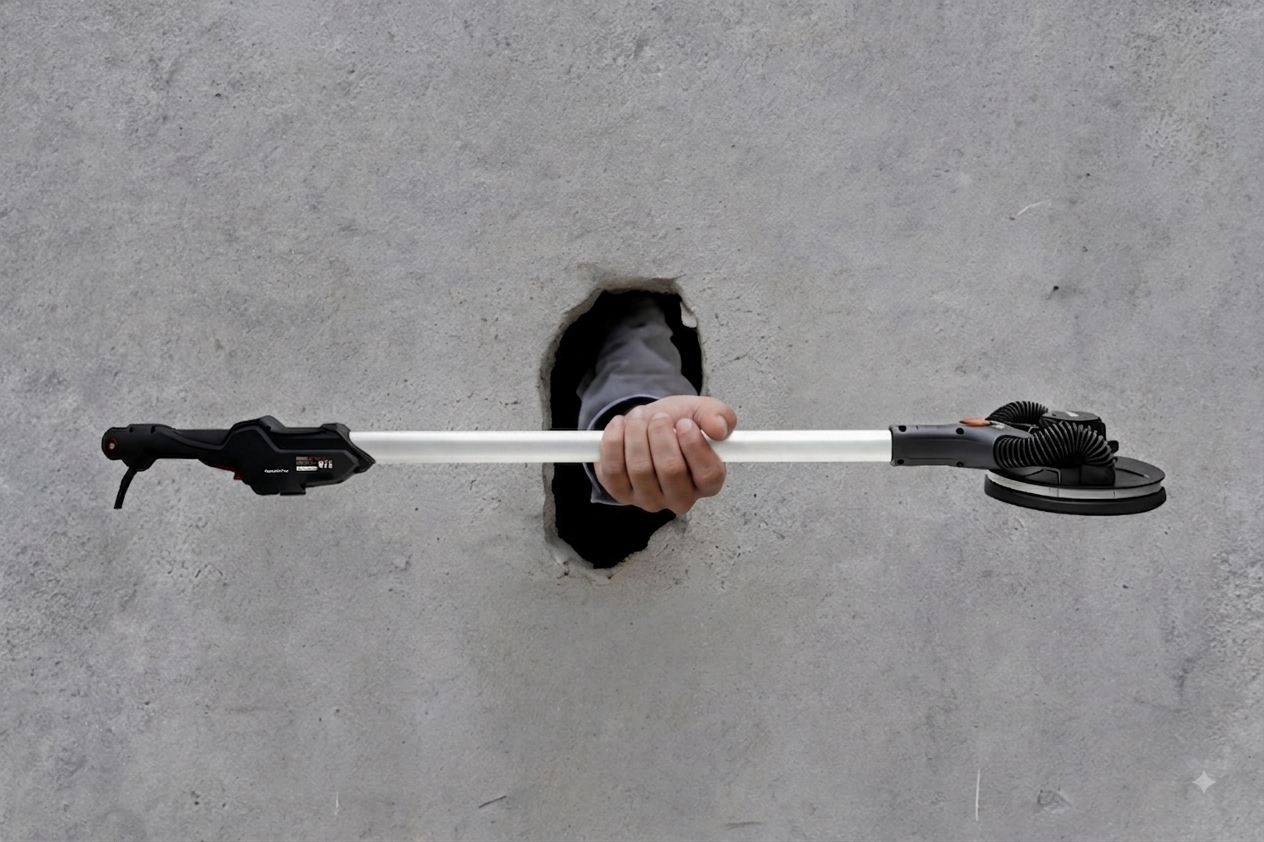
MBLS400B balanced and lightweight drywall sander held through a wall opening

Two Technologies, One Clear Upgrade

The way the sanding head moves decides everything about your finish — and the motor type decides how long the tool lasts. Here’s what each one actually is.

Traditional — Rotary Brushed

The spinning head

The pad spins in circles at 600–1,900 rpm. It takes material off fast and the brushed motor is cheap to build — and cheap to rebuild when the carbon brushes wear out.

  • Circular motion leaves swirl marks in the finish
  • Brushed motor loses power as brushes wear
  • Carbon brushes need replacing, on a schedule
Modern — Orbital Brushless

The oscillating head

The pad moves in a small 4 mm orbit, 4,000–8,500 rpm. The motion cancels itself out, so there are no directional marks. The brushless motor has no brushes to wear out.

  • Random orbit leaves no visible sanding marks
  • Brushless motor holds speed under load, stays constant over time
  • Nothing to replace — no carbon brushes at all
Why we can say this: we build both types. The MBLS400B is the brushless orbital flagship; the MLS820B is our rotary brushed model. This page is the same comparison we’d give you over email — spec by spec.

MBLS400B vs MLS820B, Spec by Spec

Same 9″ disc, same working length, same weight class. The differences are exactly where you can’t upgrade a tool later: the motor and the motion.

Specification MBLS400B — Orbital Brushless MLS820B — Rotary Brushed
Motor Brushless, maintenance-free Brushed — carbon brushes to replace
Motion Orbital, 4 mm stroke Rotary (spinning)
Speed 4,000–8,500 rpm 600–1,900 rpm
Dust port 45 mm — upgraded suction 38 mm
Power 400 W (brushless) 820 W
Abrasive disc 9″ (225 mm) 9″ (225 mm)
Backing pad 8.5″ (215 mm), interchangeable 8.5″ (215 mm), interchangeable
Weight 3.2 kg 3.5 kg
360° LED / soft start / constant speed Yes / Yes / Yes Yes / Yes / Yes
Working length / cord 1.5 m / 4 m 1.15–1.65 m / 4 m

The power gap isn’t what it looks like. Rotary sanders need more watts because they push a spinning disc through the material. The brushless orbital gets the same job done with a more efficient motor and high-frequency oscillation — less dust, no re-sanding.
The takeaway: same discs, same reach, same price class. The motor and the motion are the upgrade — and those are the two parts you can’t add to a tool later.
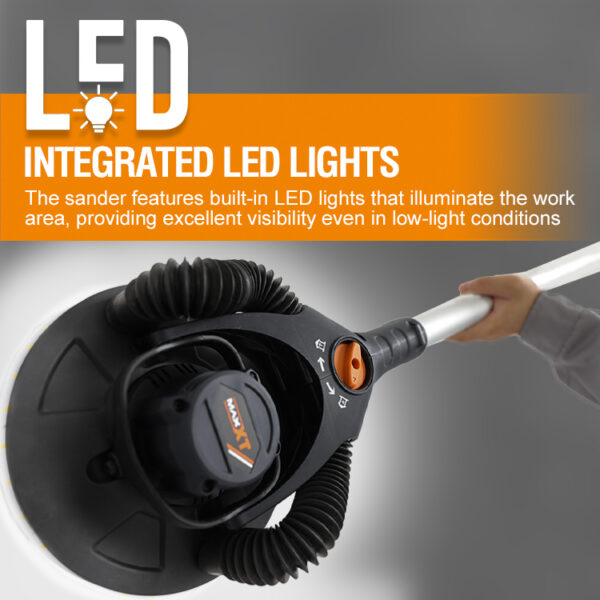
MBLS400B integrated LED lights illuminating the sanding area

Nothing to replace. Ever.

Brushless, Maintenance-Free

A brushed motor loses power as its carbon brushes wear, and eventually someone has to open the tool up and replace them. It’s not a question of if — it’s a maintenance item. The MBLS400B’s brushless motor has nothing to wear down — it holds speed under load and delivers the same output on year three as on day one.

No carbon brushes to buy or replace
Constant speed under load, even on fresh joint compound
360° LED ring lights the seam — no shadows, no missed spots in low light
Orbital motion diagram showing the random orbit that minimizes sanding marks

It’s not the grit — it’s the motion

No Swirl Marks

A spinning disc cuts in one direction, so it leaves circular marks in the compound. On a ceiling, in bright light, you see them the moment you step back.

An orbital pad moves in a small 4 mm random orbit that cancels its own marks out. You finish with the same disc you started with — no stepping down to a finer grit just to hide scratches, no sanding the same wall twice.
Random orbit cancels directional sanding marks
Flatter finish, less primer and paint used
Fewer re-work callbacks on the same job
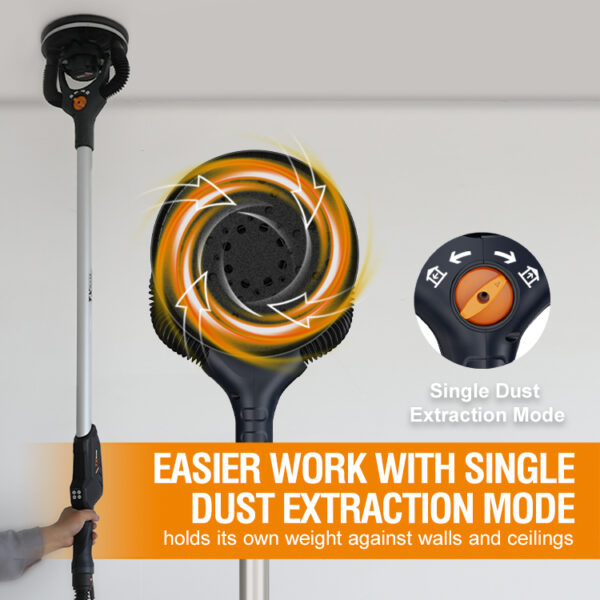
MBLS400B dust extraction modes with single dust extraction selected, holds its own weight on walls and ceilings

3.2 kg that holds its own weight

Built for Ceilings

The wider 45 mm port pulls more air through the pad, so dust goes into the bag instead of into your face, your ladder, or the freshly painted room next door.

At 3.2 kg, the head holds its own weight against a ceiling. That’s the difference between finishing a room and fighting the tool for the whole way up.

45 mm port — upgraded suction over the 38 mm class
Dual / single dust extraction modes to match your extractor
3.2 kg head stays put on ceilings — less arm fatigue

Watch It Work

Upgraded suction, ceiling-ready, no dust cloud. Forty-five seconds of the MBLS400B on real surfaces.

Where It Earns Its Keep

Lightweight and balanced MBLS400B held at ceiling height

Ceiling work

The head’s weight works with you — 3.2 kg holds flat against the ceiling while the LED ring lights the seam and the dust goes in the bag.
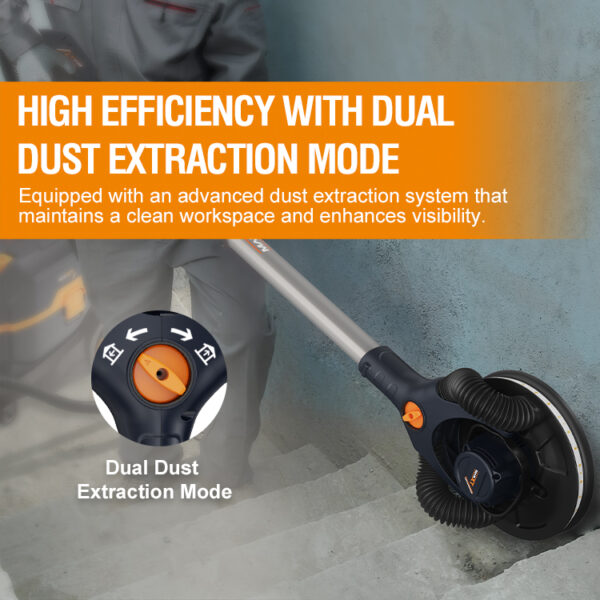
Worker sanding a concrete wall with the MBLS400B dual dust extraction

Walls & large areas

1.5 m working length covers most of a wall without a ladder, and the dual dust modes match the extractor you already own.

MBLS400B 180 degree flexible head reaching corners and tight spots

Corners & tight spots

180° flexible head reaches the awkward bits between ceiling and wall where a fixed head can’t go.

Questions We Actually Get

My sander leaves swirl marks no matter what grit I use. Is that me or the machine?
It’s the machine. A spinning (rotary) pad cuts in one direction and leaves circular marks — that’s inherent to the design, not the operator. An orbital pad moves in a random 4 mm pattern that cancels its own marks, so the finish comes out flat with the same grit.
How often do I actually need to replace carbon brushes?
Depends on use — typically after a few hundred hours on a busy job site, and you only notice because the tool starts losing power and sparking. It means opening the tool, buying the brushes, and losing a work hour. The MBLS400B’s brushless motor doesn’t have carbon brushes, so this maintenance item simply doesn’t exist.
400 W vs 820 W — isn’t less power worse?
Rotary sanders need the higher wattage because they push a spinning disc through the material at low speed. The brushless orbital uses a more efficient motor at high oscillation frequency, which cuts just as fast with far less vibration and dust. Wattage on its own doesn’t tell you how a sander finishes — the motion does.
Can it sand ceilings without me holding it up the whole time?
Yes. At 3.2 kg the head is light enough to hold its own weight against the ceiling, and the 45 mm dust port keeps the dust moving into the bag instead of down onto you. The LED ring lights the work area so you can see the seam you’re sanding.
What sanding discs does it use?
9″ (225 mm) discs on an 8.5″ (215 mm) backing pad — the same disc size as the MLS820B and the standard in this class. If you already stock discs for a 9″ rotary sander, they fit the MBLS400B.
Does it hook up to the extractor I already have?
The 45 mm connection is the standard pro-class size, and the kit ships with 47 mm and 35 mm adapters so it fits the extractors most crews already run.

The MBLS400B Is the Upgrade, Not the Compromise

Brushless motor, orbital finish, upgraded suction — at the same price class as the traditional tools crews already buy. Ask us for the dealer quote.

Need a traditional rotary sander? The MLS820B is still in the lineup.

Get in Touch

Please enable JavaScript in your browser to complete this form.
en_USEnglish